
Sustainable Fashion: Best Thrift Stores and Local Brands in SA
Discover the best sustainable fashion in SA. From top thrift stores in JHB & CPT to local brands like Maxhosa. Build an eco-friendly wardrobe today.
Let’s be real for a second, Mzansi. We all love the “drip.”
There is a specific feeling you get when you walk into a room wearing an outfit that fits perfectly, looks expensive, and—crucially—nobody else is wearing. But for too long, we’ve been fed the lie that to look good, we need to buy cheap, plastic clothes from international fast-fashion giants that fall apart after three washes.
You know the ones. You order online, wait three weeks, pay customs (eish!), and when it arrives, it looks nothing like the picture.
But the tide is turning. In 2026, the biggest flex isn’t wearing a mass-produced item that 5,000 other people have. The biggest flex is saying, “Thanks, it’s vintage,” or “Thanks, it’s by a local designer.”
Sustainable fashion is no longer just for hippies with hemp tote bags. It is the new standard for the cool kids in Braamfontein, the creatives in Woodstock, and the professionals in Sandton.
As Thando, your City Insider, I’ve spent years curating a wardrobe that balances “Soft Life” aesthetics with a hard stance on quality. In this ultimate guide, we are going to explore the best thrift stores, the hottest local brands, and how to build a wardrobe that respects the planet, your wallet, and your style.
Why “Sustainable Fashion” is the Ultimate Soft Life Flex
Before we drop the names of the best stores, we need to understand the why. Why should you care about Sustainable Fashion?
1. The Quality Factor
Fast fashion is designed to be disposable. Sustainable fashion—whether it’s a pre-loved leather jacket from the 90s or a locally made linen shirt—is designed to last. When you buy quality, you buy it once. That is the definition of financial efficiency.
2. The “Unique” Factor
Nothing kills a vibe faster than showing up to a wedding and seeing two other people in the same printed dress from a mall chain store. Thrifting and buying local guarantees exclusivity. You are curating a look that is uniquely yours.
3. The Economic Factor (Local is Lekker)
When you buy from a local designer, you aren’t paying for a CEO’s third yacht in California. You are paying for a seamstress in downtown Joburg to feed her family. You are keeping Rands circulating in our economy. That is a boss move.
To understand how investing in your wardrobe fits into your broader financial picture, you need to read my deep dive on The Art of Living Well in South Africa: Balancing Comfort, Culture, and Cost. It explains why spending R1000 on one good shirt is better than spending R200 on five bad ones.
Part 1: The Thrift Revolution (Pre-Loved Gold)
Thrifting in South Africa has exploded. It’s no longer about digging through dusty bins (unless you like that); it’s a curated, high-end experience.
Online Thrifting: The Digital Hunt
If you don’t have time to browse physical rails, the internet has your back.
1. Yaga (The Giant) Yaga has completely democratized Sustainable Fashion in SA. It’s like Instagram, but everything is for sale.
- Thando’s Strategy: Don’t just search “dress.” Search for specific high-quality brands like “Country Road,” “Trenery,” “Poetry,” or “Vintage Leather.”
- The Safety Net: Yaga holds the money until you receive the item and confirm it’s happy. No scams, just vibes.
2. Wisi-Oi (Wear It, Sell It, Own It) This is a marketplace for the fashion-forward. The curation tends to be a bit trendier and younger. If you are looking for Y2K fashion or streetwear, this is your spot.
3. Vintage with Love This is thrifting with a conscience. They are a charity organization that sells incredible donated fashion. They hold massive pop-up sales (keep an eye on their socials) and have an online store. I’ve found Italian silk scarves here for peanuts.
Physical Stores: Johannesburg (The City of Gold)
Jozi thrifting is gritty, cool, and full of hidden gems.
- Melville (7th Street): This is the holy grail. Walk down 7th Street and you will find multiple vintage stores. Bounty Hunters is legendary for charity shop finds.
- Dream Republic (Victoria Yards): If you want a more curated, artistic experience, head to Victoria Yards. The vintage sellers here often have reworked denim and custom pieces.
- Maboneng: On weekends, the street markets are alive. You can find incredible vintage leather jackets and retro sports jerseys.
Physical Stores: Cape Town (The Vintage Capital)
Cape Town thrifting is more polished, often resembling boutique shopping.
- Observatory (Lower Main Road): The undisputed king of vintage. Stores like Bangbang Vintage offer high-end, curated vintage (think 70s suede and 80s windbreakers). It’s pricier, but the work has been done for you.
- The V&A Watershed: While mostly new local design, there are often vintage pop-ups.
- Retrodizzy: A classic for those who love quirky, colorful, true vintage pieces.
Part 2: Local Brands Killing the Game
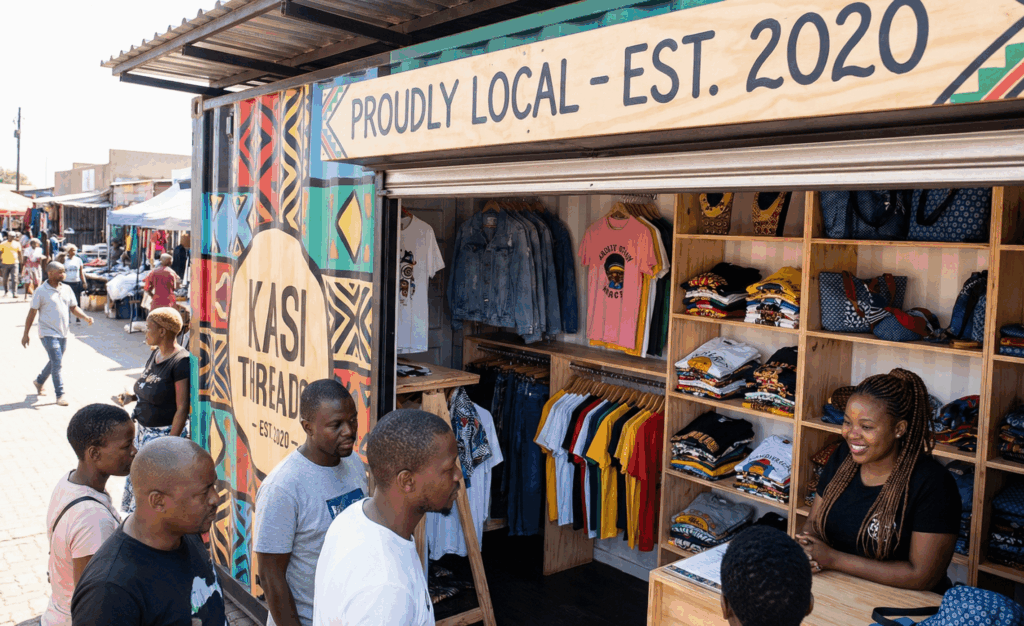
If you want to buy new, buy local. South African design is having a global moment. Our designers are winning awards in Paris and Milan, yet we often sleep on them at home.
Supporting these brands is the backbone of Sustainable Fashion in our country.
High-End Investment Pieces (The “Save Up” List)
These are expensive, yes. But they are heirlooms.
1. Maxhosa Africa Laduma Ngxokolo has created a brand that is instantly recognizable. His knitwear is iconic. It is not just a jersey; it is a piece of art inspired by Xhosa beadwork.
- The Buy: A classic Maxhosa scarf or beanie. It elevates a simple black outfit instantly.
2. Thebe Magugu The winner of the LVMH Prize. His clothes tell South African stories. While his couture is pricey, his collaborations (like with Adidas) often make his design aesthetic accessible to more people.
3. Fieldbar You have seen them. Those hard-shell cooler boxes that look like vintage luggage. Handcrafted in Cape Town.
- The Flex: bringing a Fieldbar to a braai is the ultimate 2026 status symbol. It says “I like nature, but I also like champagne.”
Accessible & Everyday Local Brands (The “Daily Wear” List)
You don’t need to be a millionaire to wear local.
1. Good Good Good Based in Cape Town, they make basics that aren’t basic. Their t-shirts are made from high-quality milled cotton. They fit better, last longer, and are ethically made.
2. Veldskoen The shoe that conquered the world. They took the traditional “Vellie” and gave it vibrant, colorful soles. They are comfortable, durable, and uniquely South African.
- Thando’s Tip: They look as good with a floral dress as they do with jeans.
3. Freedom of Movement (FOM) Started as a leather bag company in Stellenbosch, now a full lifestyle brand. Their leather boots and apparel are rugged but refined. If you want that “Old Money / Bush Lodge” aesthetic, this is it.
4. Me&B This mother-daughter duo from Durban/Cape Town makes fashion that is fun. Size-inclusive, bright prints, and comfortable cuts. It’s the antithesis of boring beige fashion.
Part 3: Building a Sustainable Capsule Wardrobe
Okay, so you know where to shop. Now, how do you put it together without going broke? The answer is the Capsule Wardrobe.
A Capsule Wardrobe is a small collection of useful clothing that you love, which changes with the seasons.
The 5-Step “Thando Strategy”
1. The “30 Wears” Rule Before you tap your card, ask yourself: “Will I wear this at least 30 times?” If the answer is no (because it’s a neon tutu for a specific party), don’t buy it. Rent it or borrow it. Sustainable Fashion is about utility.
2. Stick to a Palette Choose 3 neutrals (e.g., Black, White, Denim) and 2 accent colours (e.g., Emerald Green, Mustard). If you buy a shirt that matches nothing else in your closet, it will sit there gathering dust.
3. Fabric Matters Read the label.
- Buy: Cotton, Linen, Wool, Tencel, Viscose, Leather. These breathe, age well, and are biodegradable.
- Avoid: Polyester, Acrylic, Nylon (unless it’s recycled sports gear). These are plastic. They make you sweat, they retain odours, and they take 500 years to decompose.
4. Tailoring is the Secret Weapon You found a stunning vintage Hugo Boss blazer at a charity shop for R100, but it’s a bit big? Take it to a tailor. For R200, they can nip it in. Now you have a custom-fit designer blazer for R300 total. That is how you look rich on a budget.
5. Care for Your Clothes
- Wash Less: Denim does not need to be washed after every wear.
- Cold Wash: Saves electricity and preserves the fabric fibers.
- Air Dry: Tumble dryers are the enemy of clothes. The African sun dries clothes for free.
The Problem with “Greenwashing”
We need to be sharp. As Sustainable Fashion becomes trendy, big brands are trying to trick us. This is called Greenwashing.
Signs of Greenwashing:
- Vague Buzzwords: A tag that says “Eco-Conscious” but offers no details on why.
- The “Recycled” Lie: A brand releases a “Conscious Collection” made of recycled bottles, but the other 99% of their stock is cheap polyester produced in sweatshops.
- Green Packaging: Just because the tag is green and looks like cardboard doesn’t mean the clothes are ethical.
How to Verify: Check websites like Good On You. They rate brands based on their treatment of people, the planet, and animals. Also, look for reputable local certifications or transparency reports on the brand’s website.
The Financial Reality: Cost Per Wear
Let’s do the math. This is the argument you use when your friends say local brands are “too expensive.”
Scenario A: Fast Fashion
- Item: Trendy Polyester Dress
- Cost: R400
- Wears: 4 (It loses shape, buttons pop off, or goes out of style).
- Cost Per Wear: R100
Scenario B: Sustainable Local Brand
- Item: Locally made Linen Dress
- Cost: R1,200
- Wears: 60 (Over 3 years).
- Cost Per Wear: R20
The “expensive” dress is actually 5 times cheaper in the long run. Plus, if you look after it, you can resell it on Yaga for R600. You cannot resell the Shein dress; it goes to the landfill.
Thrifting Routes for the Weekend
Ready to hit the streets? Here are two itinerary suggestions for a Saturday morning.
The Joburg “Vintage Crawl”
- Start: Breakfast at 44 Stanley (Milpark). Browse the high-end local boutiques there (like Guillotine).
- Move: Drive to Melville. Hit Bounty Hunters and the charity shops on the side streets.
- End: Victoria Yards. Grab a pizza, watch the artists work, and browse the denim rework stalls.
The Cape Town “Retro Route”
- Start: Coffee in Observatory. Walk Lower Main Road. Hit Bangbang Vintage and Nevernew.
- Move: Head to Woodstock Exchange. Browse the local design studios.
- End: The Watershed at the V&A. It’s touristy, but the concentration of local design (jewelry, fashion, art) is unmatched.
Wear Your Values
Fashion is powerful. It is the skin we choose to show the world.
Choosing Sustainable Fashion in South Africa is about more than just clothes. It is a vote for the kind of country we want to live in. A country where we value craftsmanship over speed. A country where we support our neighbors’ businesses. A country where we create less waste.
So next time you get that urge to “add to cart” on a fast-fashion app, pause. Open Yaga instead. Visit a local market. Check out a local designer.
You will look better, you will feel better, and your wallet will thank you in the long run.
Are you a thrifting pro or a local brand loyalist? Drop your favourite hidden gem store in the comments—let’s plug each other!
FAQ: Sustainable Fashion in SA
Q: Is second-hand clothing hygienic?
A: Yes, absolutely. Most reputable vintage stores wash or steam items before selling. For online buys, simply wash the item when it arrives. A hot wash with good detergent kills any germs. It’s no different from sleeping in a hotel bed.
Q: Why are local South African brands expensive?
A: They aren’t “expensive”; they are priced accurately. Fast fashion is artificially cheap because it exploits cheap labour and bypasses environmental regulations. Local brands pay fair wages, use ethical fabrics, and produce in smaller batches, which costs more per unit.
Q: Can I thrift if I am plus-size?
A: It can be harder, as vintage sizing runs small. However, brands like Me&B are incredibly size-inclusive. Also, look for “oversized” vintage men’s shirts and jackets—they look incredibly chic on curvy bodies.
Q: How do I sell my own clothes on Yaga?
A: It’s easy. Take clear photos in natural light (this is key!). Be honest about any defects. Price it fairly (usually 30-50% of the original price). Write a fun description. Ship it promptly when it sells.
Q: What is “Upcycling”?
A: Upcycling is taking an old item and making it better. For example, turning a pair of jeans with a hole in the knee into denim shorts, or tie-dyeing a stained white t-shirt. It’s a huge trend in Sustainable Fashion.