
The Role of Agriculture in South Africa: Food Security and Economy
Role of Agriculture in South Africa
When we think of the South African economy, images of gold mines, bustling Johannesburg stock exchanges, or automotive assembly lines often come to mind. Yet, if you strip away the steel and the concrete, the true heartbeat of our nation lies in the soil. The Role of Agriculture in South Africa is the foundation upon which our entire society rests. It is not merely about farmers in khakis standing in maize fields; it is about national survival, sovereign stability, and the price of the sandwich in your lunchbox.
In this deep dive, part of our broader South Africa Economic Overview, we are going to explore why agriculture is the “immune system” of our economy. We will unpack how global events, local weather patterns, and logistical challenges ripple through the farming sector and land directly in your shopping trolley.
More Than Just Farming: The Economic Backbone
To understand the true scale of agriculture, we must look beyond the raw GDP numbers. Officially, primary agriculture contributes around 2.5% to 3% of South Africa’s Gross Domestic Product (GDP). To the untrained eye, this might seem small. However, this is a classic case of “macro-economic illusion.”
Lesedi’s Economic Insight: The Multiplier Effect
Think of agriculture as the roots of a massive tree. The roots might only be a small percentage of the tree’s total volume, but without them, the branches (manufacturing), leaves (retail), and fruit (exports) cannot exist. If the roots get sick, the whole tree withers.
When you factor in the entire “agro-processing” value chain—transporting the grain, milling the flour, baking the bread, packaging it, and selling it at the retailer—the sector’s contribution to the economy skyrockets to roughly 12% of GDP. This sector is a massive earner of foreign currency. South African citrus, wines, macadamia nuts, and deciduous fruits are world-famous. When we export these goods, we bring Dollars, Euros, and Pounds into the country, which helps to stabilise the Rand.
Food Security: The Difference Between Hunger and Health
The Role of Agriculture in South Africa is most critically measured by “Food Security.” In economic terms, food security isn’t just about whether there is enough food in the country (National Availability); it is about whether you can afford to buy it (Household Access).
South Africa is technically “food secure” at a national level. We produce enough calories to feed our population and still export to our neighbours. We are the breadbasket of Southern Africa. However, at a household level, the picture is different. High unemployment and inflation mean that while the shelves are full, many wallets are empty.
The “Farm to Fork” Price Journey
Why does a bag of potatoes cost R60 today when it was R40 last year? The price you pay is determined by a complex chain of inputs:
- Diesel Prices: Tractors and delivery trucks run on diesel. When global oil prices rise, the cost of planting and delivering rises.
- Fertiliser Costs: Most fertilisers are imported or made using global commodities. Geopolitical tension (like the war in Ukraine/Russia) sends these costs soaring.
- Electricity: Farmers need power for irrigation pumps and cold storage. Eskom
The Inflation Connection: Why Your Trolley Costs More
We cannot discuss agriculture without revisiting inflation. As we detailed in our South Africa Economic Overview, food inflation is often the most volatile part of the Consumer Price Index (CPI).
Food inflation is “sticky.” When input costs go up, shelf prices go up quickly. When input costs go down, shelf prices come down slowly. This phenomenon frustrates consumers and economists alike. Currently, the pressure on the agricultural sector is shifting from “production costs” to “climate costs.”
Impact Analysis: Weather Events vs. Food Prices
Weather vs. Wallet: How Climate Change Pricing Works
| The Weather Event | The Agricultural Impact | The Result for Your Wallet |
|---|---|---|
| El Niño (Drought) | Reduced rainfall in maize regions. | Staple Hike: Higher prices for maize meal, meat, and poultry. |
| La Niña (Heavy Rain) | Flooding and lower temperatures. | Veggie Spike: Damage to tomatoes/potatoes causes sudden costs. |
| Heatwaves | Stress on livestock and fruit. | Dairy Inflation: Lower milk production pushes up dairy costs. |
Logistics: The Weak Link in the Chain
One of the most pressing challenges threatening The Role of Agriculture in South Africa in 2026 is logistics. You can grow the best avocados in the world in Limpopo, but if you cannot get them to the port in Durban or Cape Town efficiently, they rot.
The deterioration of our rail network (Transnet) has forced farmers to put more trucks on the road. This has two negative effects:
- Higher Costs: Road transport is significantly more expensive than rail.
- Road Damage: Heavy trucks destroy provincial roads, increasing maintenance costs for everyone.
Furthermore, delays at our ports mean that perishable goods often miss their export windows. When South African grapes arrive late in Europe, they lose value, or worse, are rejected. This loss of revenue hurts the farmer’s ability to plant for the next season, creating a cycle of financial stress.
Employment: The Social Safety Net
Agriculture is a vital employer, particularly in rural areas where other industries are scarce. The sector employs roughly 800,000 to 900,000 people directly. These are not just statistics; these are livelihoods supporting extended families.
However, the nature of agricultural employment is shifting.
- The Unskilled Labour Challenge: With the introduction of minimum wage laws, farmers are under pressure to mechanise (use machines) to keep costs down. This threatens unskilled jobs.
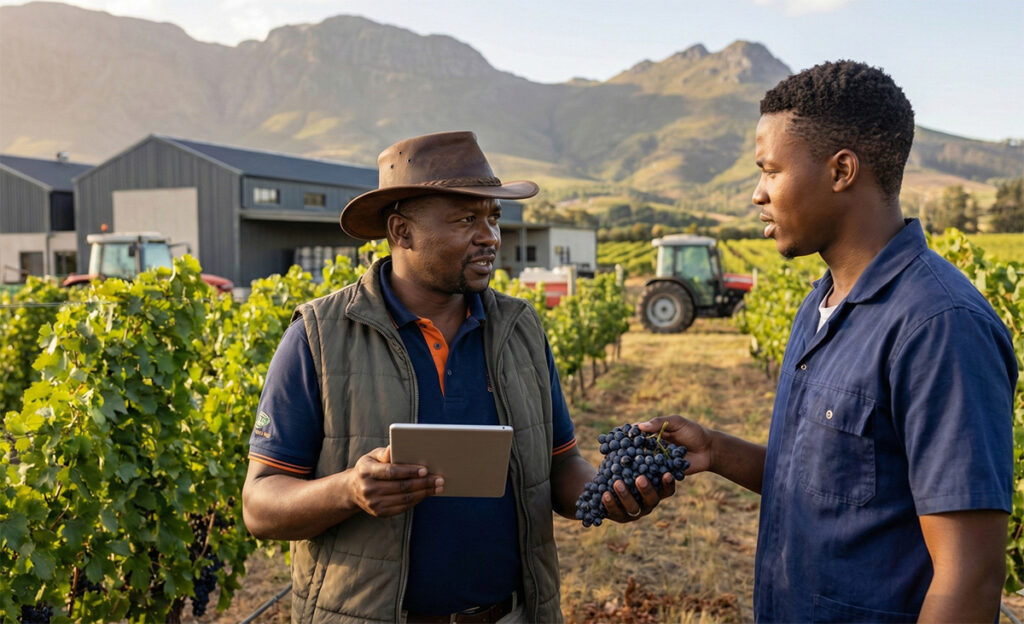
- The Skilled Labour Opportunity: Conversely, modern farming requires drone operators, data analysts, and bio-technicians. There is a growing demand for youth to enter the sector not as labourers, but as “Agri-Technologists.”
The Future: Technology and Resilience
Despite the challenges, the South African farmer is legendary for resilience. The Role of Agriculture in South Africa is evolving through technology to combat climate change and economic instability.
1. Precision Farming
Farmers are using satellite data and soil sensors to apply water and fertiliser exactly where it is needed, down to the centimetre. This reduces waste and costs, keeping food prices as stable as possible.
2. Agrivoltaics (Solar Farming)
To beat load shedding and rising electricity costs, farmers are installing massive solar plants. Some are even growing crops under solar panels (Agrivoltaics), which generates power while protecting crops from the harsh sun and reducing water evaporation.
3. Biological Solutions
With the cost of chemical fertilisers rising, there is a massive shift toward biological farming—using natural predators to fight pests and organic composts to feed the soil. This not only lowers costs but creates healthier food for the consumer.
Export Parity Pricing: A Double-Edged Sword
A common question I get asked is: “Lesedi, if we grow maize here, why do we pay international prices for it?”
This is due to Export Parity Pricing. Because our farmers trade on the global market, the local price of commodities (like wheat and maize) is linked to the price on the Chicago Mercantile Exchange.
- The Good: It ensures our farmers get a fair global price, keeping them in business.
- The Bad: It means that if the price of corn goes up in America, it goes up in South Africa, even if we had a great harvest.
This linkage to global markets is why the exchange rate is so important. A weak Rand is great for the fruit farmer selling to Europe (earning Euros), but terrible for the chicken farmer buying feed (priced in Dollars).
Strategies for the Consumer
Understanding the macro-economics of farming is helpful, but how does it help you in the supermarket aisle? Here is how to navigate the agricultural economy:
- Eat Seasonally: Importing fruit that is out of season attracts massive transport and tariff costs. Eating what is currently being harvested locally is always cheaper.
- Buy Bulk Staples: Non-perishables like maize meal and rice are sensitive to exchange rate shocks. When you see a “low” price, it is often wise to buy a larger bag to hedge against future inflation.
- Support Local: Buying South African products supports the local value chain. Look for the “Proudly South African” logo. It ensures your money stays within our “roots,” keeping the economic tree healthy.
FAQ: Agriculture and Your Life
1. Why is meat becoming so expensive?
Meat production is grain-intensive. Animals need to eat maize and soy. When the price of these grains goes up (due to drought or global markets), the cost of raising the animal goes up. Additionally, outbreaks like Avian Flu can wipe out millions of chickens, creating a shortage that spikes prices.
2. Is land reform hurting food security?
This is a complex issue. The goal of land reform is redress and equity. The economic risk lies in uncertainty. If land is transferred without support, training, and capital, production can fall. However, successful joint ventures and commercial partnerships are proving that we can have both transformation and food security.
3. What is the biggest threat to SA farming right now?
Climate change is the long-term threat, but right now, infrastructure collapse (ports, rail, water, and roads) is the immediate crisis. Farmers can make a plan for the rain, but they cannot fix a broken port.
Cultivating a Stable Future
The Role of Agriculture in South Africa is the story of our resilience. It is a sector that faces fire, flood, drought, and economic headwinds, yet continues to put food on our tables and money in our national bank.
For the average citizen, appreciating this sector means understanding that food isn’t just a commodity; it is the final product of a miraculous, difficult, and essential journey. By understanding the pressures our farmers face—from the fuel pump to the port—we can better understand the shifting prices in our shops and the vital importance of protecting our “Green Gold.”
As we look to the future, the integration of technology and the stabilisation of our logistics networks will determine whether our agricultural sector thrives or merely survives. For the sake of our wallets and our stomachs, we must hope for the former.