
The Informal Economy: The Untapped Power of Township Businesses
Discover the untaped power of township businesses. Lesedi Dlamini explores the informal economy, from Spaza shops to the taxi industry, and its massive role in SA's future.
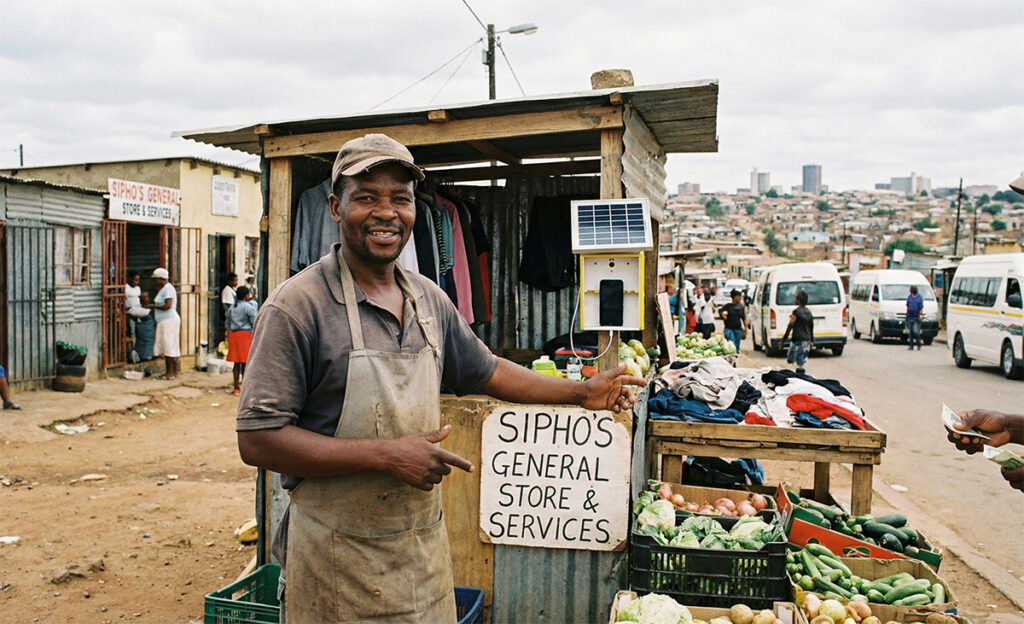
When economists discuss the South African market, they usually point to the glittering skyscrapers of Sandton, the vineyards of Stellenbosch, or the industrial hubs of Durban. They analyze the JSE (Johannesburg Stock Exchange) and fret over the Rand’s performance against the Dollar. Yet, they often ignore the economy where the majority of South Africans actually live, shop, and trade. This is The Informal Economy, often referred to as the “Kasi Economy” or the township economy.
It is a bustling, chaotic, and incredibly resilient marketplace that operates largely below the radar of official statistics. But make no mistake: it is a sleeping giant. Estimates suggest that the informal sector contributes billions to our annual GDP and supports at least 2.5 to 3 million workers who would otherwise be destitute.
In this deep dive, which complements our broader South Africa Economic Overview, we are going to walk the streets of Soweto, Khayelitsha, and Umlazi. We will unpack how Spaza shops, taxi associations, and street vendors are not just “surviving”—they are shaping the future of South African commerce.
What is the Informal Economy?
Defining The Informal Economy is difficult because, by its nature, it resists definition. It includes any economic activity that is not taxed or monitored by the government. It is the “cash economy.”
However, calling it “informal” suggests it is unorganized, which is a massive misconception. The township economy is highly structured, competitive, and governed by its own set of rules.
- The Players: It ranges from the “Gogo” selling fat cakes (vetkoek) at a school gate to a fleet owner running five minibus taxis.
- The Scale: We are talking about an ecosystem that turns over hundreds of billions of Rands annually. For global FMCG (Fast-Moving Consumer Goods) brands like Coca-Cola or Tiger Brands, the “route-to-market” into townships is their most critical growth strategy.
Lesedi’s Economic Insight: The Invisible Buffer
Think of the informal economy as the “shock absorber” of South Africa. When the formal sector sheds jobs (as we saw in the mining and manufacturing downturns), the informal sector expands. It absorbs the labour force that the corporate world leaves behind. Without it, our unemployment crisis would have collapsed the state years ago.
The Pillars of the Township Economy
To understand the power of The Informal Economy, we need to look at its three main pillars. These are the industries that keep the money circulating within the community.
1. The Spaza Shop: The Retail Giant
The humble Spaza shop is the cornerstone of township food security. These micro-convenience stores are located within walking distance of almost every home.
- Convenience vs. Cost: While a supermarket in a mall might be cheaper, the Spaza shop sells “loose” cigarettes, single eggs, or small sachets of cooking oil. They break bulk products down into affordable units for low-income households.
- Market Share: It is estimated that over 30% of all food expenditure in South Africa happens through the informal trade. This makes the collective network of Spaza shops bigger than some of our national grocery chains.
2. The Taxi Industry: The Bloodstream
If Spazas are the stomach, the minibus taxi industry is the circulatory system. It is the only sector in South Africa that is entirely black-owned, runs without government subsidy, and moves over 15 million people daily.
- Economic Impact: The taxi industry fuels the automotive aftermarket (spares, tyres, mechanics) and consumes billions in fuel.
- The Hub Effect: Wherever there is a taxi rank, a micro-economy springs up. Hawkers sell fruit, hair salons open in containers, and “shisa nyamas” feed the drivers. The rank is the “shopping mall” of the informal sector.
3. The Backroom Rental Market
Real estate is a massive, untaxed component of The Informal Economy. In many townships, the primary house is supplemented by “backrooms” built in the yard.
- Affordable Housing: These rooms provide affordable accommodation for young workers and migrants who cannot afford formal flats.
- Income Generation: For the landlord (often an elderly pensioner), the rental income from these rooms is often higher than their government grant, providing a vital lifeline against inflation.
The “Township Multiplier” Effect
One of the most exciting concepts in development economics is the “Multiplier Effect.” This asks: How many times does a Rand change hands within a community before it leaves?
Historically, township economies were “leaky buckets.” People earned money in the city and spent it in the city (at malls). The township was just a dormitory. However, this is changing.
- Local Consumption: As bigger retail centres open in townships and local brands (like local sneaker brands or craft beers) gain popularity, money is staying in the Kasi longer.
- Service Density: You no longer need to go to town to get a haircut, fix your car, or get legal advice. These services are now available locally, often provided by skilled youth who couldn’t find corporate jobs.
Challenges: Why Potential is Stalled
Despite the vibrancy, The Informal Economy faces structural hurdles that prevent a Spaza shop from becoming a supermarket or a mechanic from becoming a factory.
1. The Funding Gap
Banks are designed for the formal world. They ask for 6 months of bank statements, audited financials, and collateral (title deeds). A cash-based township business often has none of these, even if they are highly profitable.
- The Result: Businesses cannot borrow capital to expand, buy bulk stock, or upgrade equipment. They are stuck in a “survivalist” mode.
2. Infrastructure and Crime
Load shedding hits townships harder because “cable theft” often leaves areas dark for days after the power is supposed to return. Additionally, crime is a “tax” on business. Many shop owners pay “protection fees” to local gangs, which eats into their thin margins.
3. Regulation and Red Tape
The “Township Economy Act” (specifically in Gauteng) aims to make it easier to rezone land and get trading permits. However, on the ground, many entrepreneurs still face harassment from police for trading on pavements or operating without licenses that are too expensive to obtain.
The Digital Revolution: Cash to Card
The biggest shift in 2026 is the digitization of The Informal Economy. For decades, “Cash was King.” But cash is risky (heists) and expensive to manage.
Fintech companies like Yoco, Kazang, and Mukuru have revolutionised the sector.
- Card Machines: You can now tap your card to buy an apple from a street vendor. This builds a “digital footprint” for the merchant.
- Data Lending: Because these fintechs can see the merchant’s daily sales history, they are starting to offer loans based on turnover rather than collateral. This is finally solving the “Funding Gap.”
Lesedi’s Economic Insight: The Data Goldmine
The next billionaires in Africa won’t be miners; they will be the people who organize the data of the informal sector. Knowing exactly what brand of maize meal sells best in Tembisa on a Friday afternoon is information worth billions to manufacturers.
The Role of Stokvels: The People’s Bank
We cannot talk about township finance without mentioning Stokvels. These are community savings clubs where members contribute a fixed amount monthly and take turns receiving a lump sum.
- Liquidity: The National Stokvel Association of South Africa (NASASA) estimates that Stokvels hold over R50 billion in savings annually.
- Evolution: Stokvels are no longer just for buying groceries in December. We are seeing “Property Stokvels” buying land, “Investment Stokvels” buying shares on the JSE, and “Burial Societies” acting as micro-insurers. This is the informal economy creating its own banking system.
Strategies for the “Kasi Entrepreneur”
If you are operating in this sector, or looking to invest in it, here is the roadmap for 2026:
- Formalize to Scale: You don’t need to wear a suit, but you do need to register your business (CIPC) and separate your business money from your personal money. This is the first step to getting funding.
- Leverage Technology: Use free tools like WhatsApp Business to market to your local community. Use a card machine to track your sales.
- Collaborate: Small businesses have small buying power. If five Spaza shops combine their orders, they can negotiate bulk discounts from wholesalers, increasing their profit margins.
Why Corporate SA is Waking Up
For years, big business ignored the township. Now, they are rushing in. Malls are being built in rural areas. Banks are launching “low income” products. Insurance companies are selling policies via SMS. Why? Because the formal market is saturated. The growth is in The Informal Economy.
However, there is a tension here. When a big mall opens in a township, it often kills the local Spaza shops and butcheries. True economic development requires a partnership—where big retailers source produce from local township farmers, rather than just extracting cash from the community.
FAQ: Understanding the Kasi Market
1. Do informal businesses pay tax?
Many do, though not always Income Tax. They pay VAT on every item they buy from wholesalers. They pay fuel levies. As they digitize and grow, more are entering the formal tax net to access government incentives.
2. Is it safe to invest in township businesses?
Like any investment, there is risk. However, the returns can be significantly higher than in the saturated suburbs. The key is local knowledge. You cannot run a township business remotely from a Sandton office; you need community buy-in.
3. What is the “Township Economy Act”?
This is legislation (led by Gauteng) designed to remove bylaws that hinder township businesses. It aims to set up a fund to support SMMEs and mandate that government departments buy a percentage of their goods from township suppliers.
The Engine Room of the Future
The Informal Economy is not a waiting room for the formal economy; it is a destination in itself. It is a place of incredible innovation, where an old shipping container becomes a bakery and a backyard becomes a rental empire.
As we noted in our South Africa Economic Overview, South Africa’s growth depends on firing up all its engines. For too long, we have only fueled the formal engine. By recognizing, funding, and respecting the power of township businesses, we can unlock a level of inclusive growth that no government policy alone could ever achieve.
The hustle is real, but so is the potential. The future of South Africa is being sold, one transaction at a time, on the dusty corners of our townships.