
Remote Work Opportunities: Earning Dollars/Pounds Living in SA
Unlock high-paying remote work opportunities in 2026. Zama explains how South Africans can earn Dollars and Pounds while living locally, covering tax, logistics, and job platforms.
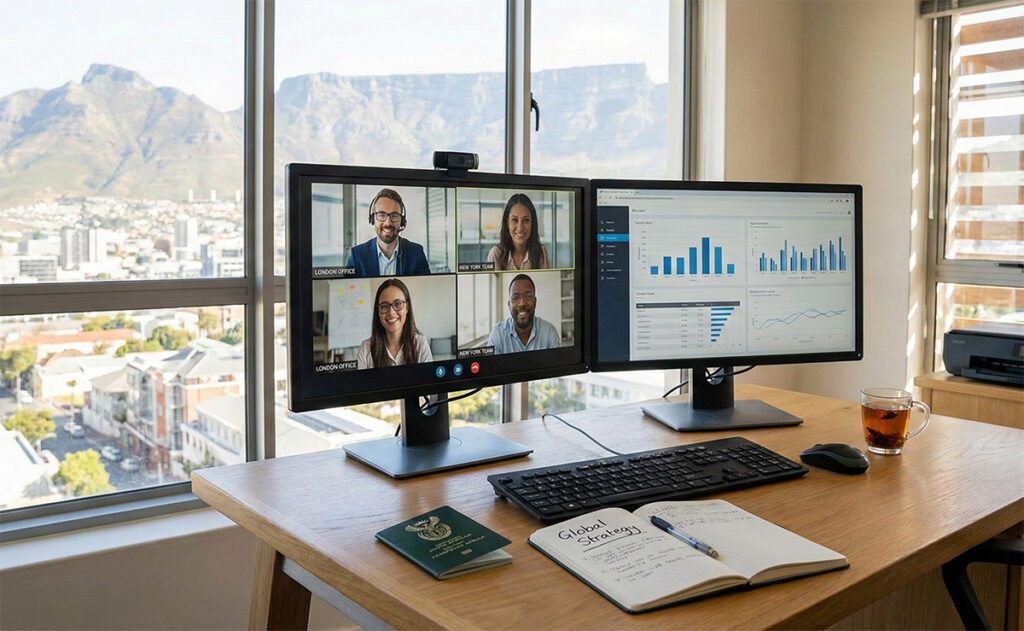
For many South African professionals, the ultimate career hack in 2026 isn’t just climbing the corporate ladder in Sandton or landing a government tender—it is mastering the art of “geo-arbitrage.” This economic strategy involves earning in a strong currency like the US Dollar (USD), British Pound (GBP), or Euro (EUR), while spending in South African Rands (ZAR). With the exchange rate consistently hovering around R18–R20 to the Dollar and R23–R25 to the Pound, securing international remote work opportunities can instantly double or triple your disposable income without requiring you to emigrate.
However, the “Digital Nomad” or “Remote Contractor” lifestyle is often romanticised on social media with pictures of laptops on beaches. The reality is more complex. Landing these roles requires more than just a reliable fibre line; it requires a strategic shift in how you position yourself as a global asset. It demands a sophisticated understanding of international work cultures, tax compliance, and digital infrastructure. If you are still assessing how your current skills fit into the broader local economy, start by reading our guide on navigating the South African job market to establish a baseline before pivoting to international waters.

Why International Companies Are Aggressively Hiring South Africans
It is a common misconception that foreign companies only hire South Africans because we are “cheap labour.” While cost efficiency is a factor, it is not the only driver. In 2026, South Africa has solidified its reputation as a premier talent hub for three specific reasons:
1. The “Goldilocks” Time Zone (GMT+2)
South Africa operates on GMT+2. This is a massive strategic advantage compared to talent pools in India (GMT+5:30) or the Philippines (GMT+8).
- For UK/Europe: We are on the same time zone as Berlin and Paris, and only one or two hours ahead of London. This allows for real-time collaboration without anyone working graveyard shifts.
- For US East Coast: We are 6–7 hours ahead of New York. This allows for a perfect “handover” workflow where a South African can complete tasks during their day and have them ready on the New York manager’s desk by the time they log on at 9:00 AM.
2. Cultural and Linguistic Compatibility
South African English is globally understood, neutral, and professional. Furthermore, our corporate governance, legal frameworks, and accounting standards (IFRS) are closely aligned with British and Commonwealth systems. This reduces the “training friction” for international employers—they don’t need to teach us how to conduct a board meeting or draft a professional email.
3. High-Level Skill Sets at Competitive Rates
Global companies are facing a talent shortage in specialised fields like software engineering, data science, and digital marketing. A senior developer in London might cost a company £80,000 (approx. R1.8 million) per year. A South African developer with the same skills might be delighted with £45,000 (approx. R1 million). The company saves money, and the South African earner moves into the top 1% of local earners.
Zama’s HR Secret: When negotiating your rate with a US or UK company, never anchor your price to your current Rand salary. Anchor it to their market rate. If a role pays $5,000/month in the US, do not offer to do it for $1,500 just because that is a high salary in SA. Aim for $3,000–$3,500. You are still a bargain to them, but you are earning a premium locally. Know your worth in their currency.
Top Sectors for Foreign Income: Beyond Coding
You do not need to be a Python developer or a Cloud Architect to earn dollars. While the tech sector is the largest employer of remote talent, the “knowledge economy” is broad. Here are the fastest-growing sectors for South Africans in 2026:
Specialised Virtual Executive Assistance
We are not talking about basic data entry or answering phones. High-level Executive Assistants (EAs) for CEOs in Silicon Valley or Founders in London are in high demand. These roles require high emotional intelligence, project management skills, and the ability to “manage up.”
- Income Potential: $2,000 – $4,000 per month.
- Key Skills: Notion, Slack, Google Workspace, and impeccable communication.
Digital Marketing & Performance Media
If you can manage Google Ads, Facebook (Meta) Business Manager, or write compelling SEO copy, you can work for agencies worldwide. International agencies often outsource the “grunt work” of campaign management to skilled South Africans who can monitor budgets and tweak creative assets.
- Income Potential: $25 – $60 per hour.
- Key Skills: Google Analytics 4, Copywriting, SEO tools (Semrush/Ahrefs).
Financial Analysis & Bookkeeping
US and UK SMEs often hire remote bookkeepers who understand cloud accounting software. Because South African Chartered Accountants (CAs) and accountants are highly trained, they are prized for their attention to detail.
- Income Potential: $30 – $80 per hour depending on qualifications.
- Key Skills: Xero, QuickBooks Online, Excel (Advanced).
Customer Success Management (SaaS)
Tech companies (Software as a Service) need people to onboard new clients, conduct training demos, and solve retention problems. This is a step up from “customer support” and involves relationship management.
- Income Potential: $3,000 – $5,000 per month.
- Key Skills: CRM management (Salesforce/HubSpot), presentation skills.
The Logistics: Getting Paid, Taxes, and Contracts
Earning foreign currency introduces administrative complexities that you must manage professionally to avoid trouble with SARS or your bank.
1. Structuring Your Income (SARS Compliance)
Living in South Africa means you are a tax resident here, even if your employer is in Texas. You are taxed on your worldwide income.
- Provisional Tax: Most remote workers are classified as “Provisional Taxpayers.” You will need to file returns twice a year (August and February) using the IRP6 form to prevent a massive tax bill at year-end.
- The 183-Day Myth: Do not confuse the “Section 10(1)(o)(ii)” exemption with remote work. That exemption generally applies if you physically work outside of SA for more than 183 days. If you are sitting in your home office in Pretoria earning dollars, you are fully liable for SA tax.
- Business Structure: For higher earners (R1m+), it may be beneficial to register a Pty Ltd company to deduct business expenses (home office, internet, equipment) before paying yourself a salary. Consult a tax practitioner.
2. Receiving Payments (Banking)
Do not simply give your foreign employer your Standard Bank or FNB IBAN and hope for the best. SWIFT transfers are slow, have terrible exchange rates, and incur high fees.
- Wise (formerly TransferWise): This is the gold standard. It gives you a local US/UK bank account number to receive funds, which you can then convert to ZAR at the mid-market rate.
- Payoneer: Widely used by platforms like Upwork and Amazon.
- PayPal: Popular but often has higher withdrawal fees to South African banks (requires an FNB link).
3. The “Independent Contractor” Reality
In most cases, foreign companies will not hire you as a full-time employee (with benefits) because they don’t have a legal entity in SA. You will sign a B2B (Business to Business) Service Agreement.
- No UIF: You cannot claim unemployment insurance if the contract ends.
- No Paid Leave: If you don’t work, you don’t earn.
- Equipment: You are usually expected to provide your own laptop and software.
Infrastructure: The “Always On” Requirement
International employers have zero tolerance for “sorry, the power went out” or “my internet is down.” To sustain a remote career earning dollars, your infrastructure must be bulletproof. You are competing with people in Europe and Asia who have 99.9% uptime.
Power Redundancy
- Stage 1-2: A simple UPS (Uninterruptible Power Supply) for your router and laptop charger might suffice.
- Stage 4-6: You need a pure sine wave inverter (3kW+) and Lithium-ion batteries to run your office for 4+ hours.
- Generators: Loud and require fuel, which makes them less ideal for video calls.
Connectivity Strategy
- Primary: A fast Fibre line (50Mbps minimum for video calls).
- Failover: You must have a backup LTE router or a 5G mobile hotspot on a different network than your fibre provider.
Once your setup is secure, the beauty of remote work is that you are not tied to a specific city. You can escape the traffic and high rent of the major metros. If you are considering a move to a “Zoom Town” (small towns with good amenities), check out our review of digital nomad life: top SA towns with fibre and vibes.
Monday Morning Checklist: Going Global
If you are ready to make the switch, here are the immediate actions to take this week:
- Audit Your LinkedIn Profile: Change your headline to include “Remote” and specific keywords (e.g., “Remote Project Manager | SaaS Specialist”). Set your “Open to Work” settings to include target countries like the United Kingdom, United States, and United Arab Emirates.
- Join Global Job Boards: Don’t just rely on Pnet. Create robust profiles on:
- We Work Remotely: Great for tech and marketing.
- Remote.co: General remote roles.
- Upwork: Good for freelancing to build a portfolio.
- LinkedIn Jobs: Use the “Remote” filter and set the location to “European Union” or “United States.”
- ATS-Proof Your CV: International companies use Applicant Tracking Systems. Ensure your CV follows US/UK standards:
- Remove: Photo, Date of Birth, ID Number, Gender, Marital Status (these are illegal asking points in the US/UK).
- Add: A “Tech Stack” section listing all software you are proficient in.
- Open a Multi-Currency Account: Sign up for a Wise or Payoneer account today so you are ready to receive your first payment.
FAQ: Remote Work for South Africans
Is it legal to work for a US company while living in SA?
Yes, absolutely. You are effectively exporting a service. The company pays you as a contractor. The main legal requirement is ensuring you declare that income to SARS in South Africa.
Do I need a work visa for the company’s country?
Generally, no. Since you are not physically entering their country to work, you do not need a visa. You remain a resident of South Africa. However, if they ask you to travel for an annual retreat, you will need a business visitor visa.
What is the best way to avoid scams?
Remote job scams are common. Red flags include:
- Interviews conducted entirely via text or WhatsApp (no video).
- Requests for you to pay for “training materials” or “software” upfront.
- Sending you a “check” to buy a laptop (the check will bounce).
- Legitimate companies will never ask you to pay money to get a job.
How do I handle medical aid and retirement?
Since you won’t have an employer contribution, you must calculate this into your rate. You are responsible for your own Medical Aid (Discovery, Bonitas, etc.) and your own Retirement Annuity (RA). A good rule of thumb is to save 15-20% of your gross foreign income for taxes and 15% for benefits.