
Crafting a South African CV: Formats Recruiters Love
Land your dream job with Zama's guide to crafting a South African CV. Master the ATS-friendly format, structure, and keyword strategies recruiters love.
Your Curriculum Vitae (CV) is not an autobiography; it is a strategic sales document. In the hyper-competitive South African job market, where a single vacancy on Pnet or LinkedIn can receive over 1,000 applications in 24 hours, your CV has exactly six seconds to impress a recruiter. If it fails to communicate your value in that brief window, you are moved to the “No” pile, regardless of how qualified you actually are.
Before you even worry about interview outfits or salary negotiations, you must master the document that gets you in the room. This guide breaks down the anatomy of a high-converting South African CV, specifically designed to pass both the Applicant Tracking Systems (ATS) and the scrutiny of human hiring managers. To understand the broader context of who is hiring and why, make sure you have read our guide on navigating the South African job market.
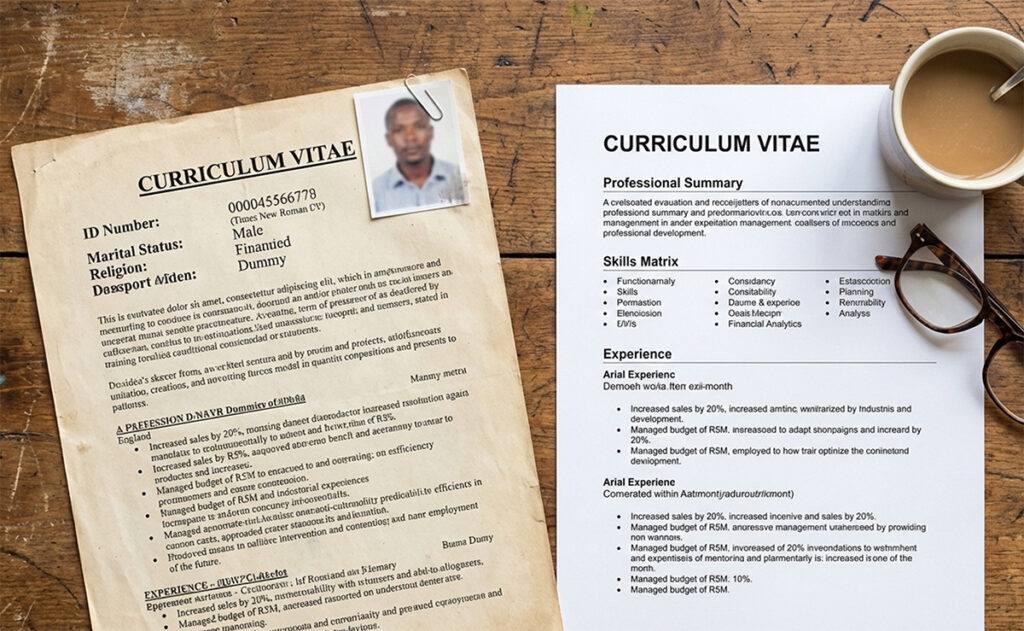
The South African Context: CV vs. Resume
One of the most common questions I get is: “Zama, should I write a one-page Resume or a longer CV?”
In South Africa, we use a hybrid model. unlike the US, where a one-page “Resume” is strict law, or Europe, where the “Europass” format reigns, South African recruiters prefer a 2 to 3-page CV. We want more detail than the Americans, but less fluff than the academics.
- Length: 2 to 3 pages maximum.
- Format: Reverse Chronological (most recent job first).
- Language: South African English (use “Programme”, “Organise”, “Labour”).
Zama’s HR Secret: Stop attaching your matric certificate, ID copy, and university transcripts to your initial application unless the job ad explicitly asks for them. These create huge file sizes that get blocked by corporate firewalls. Simply state: “Available upon request.”
The “Golden Structure” of a Modern CV
To beat the bots and please the humans, structure your CV in this exact order.
1. The Header (Keep It Clean)
Do not waste the top 20% of your page with a massive “CURRICULUM VITAE” title. We know what it is.
- Name: Big and bold (H1 size).
- Contact: Cell number (with +27 country code) and professional email ([email protected], not [email protected]).
- Location: City and Province (e.g., “Sandton, Gauteng”). Do not put your full street address; it is a security risk.
- Links: LinkedIn URL (customized) and Portfolio URL (if applicable).
2. The Professional Summary (The “Elevator Pitch”)
This replaces the outdated “Objective” statement. Do not tell us what you want; tell us what you offer. This should be 3-4 lines summarizing your years of experience, key industry, and biggest value add.
- Bad: “Hardworking graduate looking for a job in marketing to gain experience.”
- Good: “Results-oriented Digital Marketing Specialist with 5 years of experience in the SA retail sector. Proven track record of managing R500k monthly ad budgets and increasing ROI by 20%. Expert in SEO, Google Analytics, and Content Strategy.”
3. The Skills Matrix (ATS Bait)
This is the most critical section for the Applicant Tracking System. Create a table (or columns) listing your Hard Skills. Use the exact keywords found in the job description.
- Tech Stack: Python, Excel (Advanced), SAP, Xero.
- Industry Skills: Project Management, Labour Law (BCEA), Supply Chain Logistics, BEE Compliance.
4. Professional Experience (The Meat)
List your roles in reverse chronological order. For each role, include:
- Title, Company, Dates.
- The “So What?” Bullets: Do not just list duties (“Responsible for sales”). List achievements. Use the Google XYZ Formula: “Accomplished [X] as measured by [Y], by doing [Z].”
- Example: “Increased regional sales revenue by 15% (R2m) year-on-year by implementing a new CRM system and restructuring the sales funnel.”
5. Education and Certifications
Keep this concise.
- Tertiary: Degree Name, Institution, Year. (e.g., Bachelor of Commerce: Marketing Management, UNISA, 2018).
- Certifications: List relevant short courses (e.g., Google Project Management Certificate, 2024).
- Secondary: Only list your Matric school and year. Do not list subjects unless you are a fresh school leaver.
The “Delete Immediately” List: Common SA Mistakes
South African CVs are notorious for including unnecessary personal information. In 2026, this is not only outdated but can lead to bias.
- Photo: Unless you are applying for a modeling or acting gig, remove the photo. It takes up space and introduces unconscious bias.
- Personal Details: Remove Gender, Marital Status, Religion, Number of Children, and Health Status. These are irrelevant to your ability to do the job.
- ID Number: While common in the past, with the rise of identity theft, I recommend leaving this off. Put “South African Citizen” instead. You can provide the ID number when you reach the background check stage.
- “References Available on Request”: You don’t even need to write this line. It is implied. Save the space.
Formatting for the Algorithm
Recruiters use software called ATS to scan your CV before a human reads it. If your formatting is messy, the bot creates a “parsing error” and deletes your application.
- File Type: Always submit a PDF (unless a Word Doc is specifically requested). PDF locks your formatting.
- Fonts: Use clean, sans-serif fonts like Arial, Calibri, or Roboto. Avoid Times New Roman (it looks dated).
- Graphics: Avoid graphs, pie charts to show skill levels (e.g., a bar showing 80% skill in Java), and complex tables. ATS cannot read graphics.
Monday Morning Checklist: CV Audit
Open your current CV and do this 15-minute audit:
- Check Your Filename: Is your file named
CV_Final_v2_updated.pdf? Rename it toName_Surname_JobTitle_CV.pdf. - The “F” Pattern Scan: Read your CV in an “F” pattern (Top header, then scan down the left). Do your strongest keywords appear in the first 20 lines?
- Hyperlink Check: Ensure your LinkedIn and Email links are clickable.
- Action Verb Upgrade: Go through your bullet points. Change passive words like “Responsible for” or “Handled” to power verbs like “Orchestrated,” “Developed,” “Negotiated,” or “Spearheaded.”
Your CV is a living document. It should evolve as your career grows. By stripping away the clutter and focusing on value, metrics, and keywords, you transform it from a history of your past into a passport for your future.
FAQ: South African CV Questions
Should I include a Cover Letter?
Only if the application specifically asks for one, or if you are emailing the recruiter directly. If you do write one, keep it short (200 words) and link your experience specifically to their pain points.
How do I handle a gap in my employment?
Be honest but brief. “Career Sabbatical (2022–2023): Took time off for personal development and upskilling.” If you did any freelance work or courses during that time, list them.
I have 20 years of experience. How do I fit it on 2 pages?
Summarize the first 10 years. You don’t need 5 bullet points for a junior role you held in 2005. Just list the Title, Company, and Dates for older roles, or group them under an “Early Career” section.
Can I use colour?
Yes, but use it sparingly. A splash of navy blue or dark green on headers looks professional. Avoid bright neon colours or full-page background colours that make printing difficult.