
Corporate Culture in SA: Diversity, Inclusion, and BEE Basics
Decode South African business with Zama's guide to Corporate Culture in SA. Understand B-BBEE, Employment Equity, and the unwritten rules of the boardroom.
Walking into a South African boardroom is a unique experience. You might hear a greeting in isiZulu, see a strategy presentation in English, and hear a joke in Afrikaans during the coffee break. South Africa possesses one of the most complex, vibrant, and legislated corporate cultures in the world. We are often called the “Rainbow Nation,” but in the workplace, that rainbow is held together by a rigorous framework of laws, social codes, and an evolving definition of inclusivity.
For foreign multinationals setting up shop here, or for young graduates entering the workforce, the acronyms alone—B-BBEE, EE, SDL—can be overwhelming. However, understanding these isn’t just about compliance; it’s about survival and success. If you are trying to find your place in this ecosystem, start by understanding the macro-trends in our guide on navigating the South African job market.
This article decodes the DNA of South African corporate culture, moving beyond the buzzwords to explain how Diversity, Inclusion, and B-BBEE actually impact your career and your business.
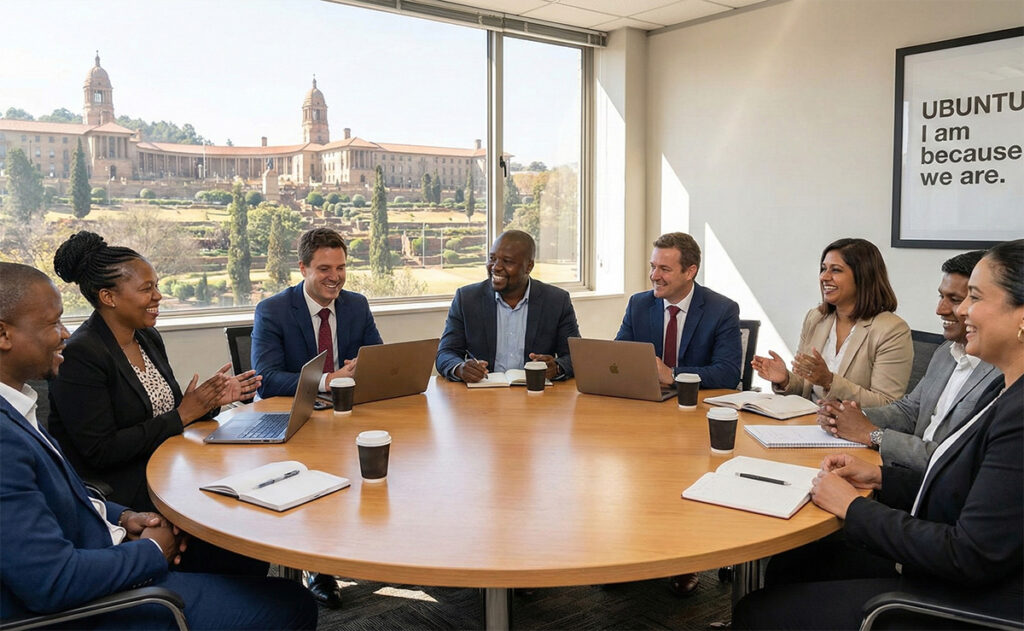
The “Rainbow” Reality: Ubuntu vs. KPIs
South African corporate culture is a hybrid. It mixes Western capitalism (deadlines, profit margins, KPIs) with African humanism (Ubuntu—”I am because we are”).
- The Conflict: Western business models often prioritize the individual and speed. South African social culture prioritizes the collective and relationship-building.
- The Resolution: Successful professionals in SA master the art of “code-switching.” They know how to drive hard bargains in the boardroom but switch to relational, respectful dialogue in the corridor.
- Social Circles: The “after-work” culture here is huge. Deals are often cemented over a braai or a golf game. Navigating these social nuances is critical. For a deep dive on this, read our guide on cultural etiquette: navigating South Africa social circles.
Zama’s HR Secret: In South Africa, greeting is mandatory. Walking past a colleague (even a subordinate) without a proper “Sawubona,” “Molo,” or “Howzit” is considered rude and damages professional trust. We connect before we correct.
B-BBEE Decoded: It’s Not Just a Scorecard
Broad-Based Black Economic Empowerment (B-BBEE) is the elephant in the room. Many misunderstand it as simply “hiring Black people.” It is far more comprehensive. It is a policy framework designed to redress the economic inequalities of Apartheid.
For a business to operate with government or large corporates, it needs a “BEE Level” (Level 1 being the best, Level 8 the worst). This level is calculated based on a scorecard:
1. Ownership (Equity)
Who owns the shares? Companies are incentivized to sell equity to Black South Africans (Black, Coloured, Indian). This drives the demand for Black partners in new ventures.
2. Management Control
Who sits on the Board and Exco? This element pushes companies to promote diverse talent into decision-making roles, breaking the “pale male” ceiling.
3. Skills Development (The Career Booster)
This is vital for you as an employee. Companies must spend a percentage of their payroll on training Black employees to earn points.
- The Opportunity: If you are an employee from a “designated group,” you have significant leverage to ask your employer to fund your MBA, short courses, or learnerships.
4. Enterprise and Supplier Development (ESD)
Companies get points for buying from small, Black-owned businesses. This is the biggest growth driver for the gig economy and SME sector.
Employment Equity (EE) and Affirmative Action
While B-BBEE is about the business entity, the Employment Equity Act is about the staff.
- Designated Groups: The law prioritizes the recruitment and promotion of Black people (African, Coloured, Indian), Women (of all races), and People with Disabilities.
- The “Quota” Myth: The law does not enforce rigid quotas (which are illegal). It enforces “Numerical Goals” based on the Economically Active Population (EAP). A company in KZN should logically have demographics reflecting KZN’s population.
Diversity & Inclusion (D&I): Beyond Race
While race dominates the conversation in SA, D&I is broader.
Gender Parity
South Africa actually ranks relatively well globally for women in senior government roles, but the private sector lags. The “Gender Pay Gap” is a major focus for HR departments in 2026.
LGBTQIA+ Rights
South Africa has one of the most progressive Constitutions in the world regarding sexual orientation. Corporate SA is generally inclusive, with many firms having “Pride” networks. Discrimination based on sexuality is a direct trip to the CCMA.
Disability
This is the most under-represented group. Companies are desperate to hire skilled professionals with disabilities to meet their EE targets. If you have a disclosed disability, you are a highly sought-after candidate.
Navigating Office Politics: The Unwritten Rules
- Language: English is the language of business. However, being able to speak a few phrases in Zulu, Xhosa, or Afrikaans buys you immense social capital. It shows respect.
- Hierarchy: Despite modern “flat structures,” South African culture often retains a deep respect for age and seniority. challenging an elder in an open meeting can be seen as disrespectful. The “praise in public, correct in private” rule is golden here.
- Religious Tolerance: You will likely work with Christians, Muslims, Hindus, and Jews. Expect prayer rooms in large offices and dietary requirements (Halal/Kosher) at company events to be standard.
Monday Morning Checklist: Your Cultural Intelligence (CQ) Audit
- Review Your Company’s BEE Certificate: Go to your company’s website. Are they Level 1 or Level 8? This tells you how aggressive their transformation strategy will be.
- Check the “Skills Plan”: Ask HR about the Workplace Skills Plan (WSP). This is the document sent to the SETA detailing who gets trained. Make sure your name is on it for next year’s budget.
- Learn a Greeting: Learn how to say “Hello” and “How are you?” in the dominant local language of your region (e.g., Sesotho in Free State, Xhosa in Eastern Cape).
FAQ: Corporate Culture Questions
Is B-BBEE “Reverse Racism”?
Legally and conceptually, no. It is defined as “restitution” or redress. It aims to level a playing field that was artificially tilted for decades. However, its implementation is often debated emotionally. As a professional, view it as a compliance framework you must navigate.
Does BEE apply to small businesses?
If your turnover is under R10 million, you are an Exempt Micro Enterprise (EME). You automatically get a Level 4 status (or Level 1 if 100% Black-owned) just by signing an affidavit. You do not need a complex audit.
Can I be fired to make space for a BEE candidate?
No. That is illegal. The Employment Equity Act prohibits firing someone solely to improve demographics. Transformation happens through “natural attrition” (replacing people who leave) or creating new roles.
What is “Fronting”?
This is a serious crime where a company pretends to have Black beneficiaries (e.g., making the gardener a Director) to get a BEE score, without giving them real power or money. Do not get involved in companies that do this; the B-BBEE Commission prosecutes this heavily.
Understanding South African corporate culture means accepting its complexity. It is a place where the past and the future collide every day at the reception desk. The professionals who thrive are those who can bridge these worlds with empathy and strategy.