
How to Build an Emergency Fund in ZAR (And Where to Keep It)
Unexpected expenses? Learn how to build an emergency fund in ZAR with Nolan's guide. Discover the best SA banks for your savings and how much you really need.
If there is one thing we know for sure in South Africa, it is that life is unpredictable. One minute you are cruising along nicely, and the next, a pothole on the N1 destroys your tyre and rim, or Eskom surges fry your fridge. If you don’t have cash on hand, these minor inconveniences turn into major financial disasters. This is exactly why learning how to build an emergency fund is the single most important step you can take to protect your peace of mind.
I often tell my clients that living without an emergency fund is like driving without insurance. You might be fine for a few months, but eventually, luck runs out. And when it does, you don’t want to be forced to swipe a credit card at 22% interest or run to a “mashonisa” (loan shark) just to keep the lights on.
I know what you are thinking: “Nolan, with the price of petrol and groceries, I have nothing left to save.” I get it. Eish, it’s tough out there. But today, we aren’t talking about saving millions. We are talking about building a safety net, one Rand at a time, so that when life happens, you are ready. Here is your blueprint on how to build an emergency fund in ZAR and, crucially, where you should stash it to get the best growth.
What Exactly is an Emergency Fund?
An emergency fund is a stash of money set aside specifically for unplanned expenses. It is not for a holiday in Durban. It is not for the new iPhone. It is not for buying Christmas presents.
It is for:
- Medical emergencies (when Medical Aid savings run out).
- Car repairs (tyres, batteries, gearbox issues).
- Home repairs (burst geysers, broken gates).
- Job loss (retrenchment is a reality in our economy).
Think of this fund as your personal insurance policy against debt. When you have this cash sitting in a bank account, an emergency becomes an inconvenience, not a crisis.
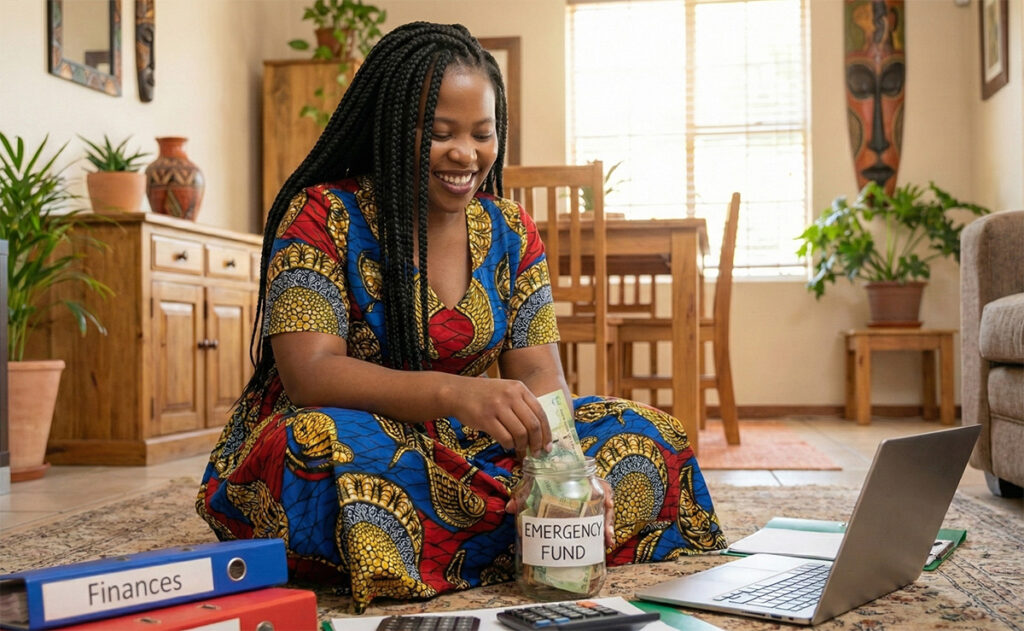
Step 1: How Much Do You Really Need?
If you Google this, American experts will tell you to save “3 to 6 months of expenses.” If you earn R20,000 and your expenses are R15,000, that means saving R45,000 to R90,000.
Let’s be honest: looking at that number is terrifying. It feels impossible, so most people don’t even start.
The “Nolan” Approach: Start with R5,000
Forget the 3 months for now. Your first goal is to save a “Baby Emergency Fund” of R5,000 to R10,000. This amount covers most common South African mishaps:
- A standard excess payment on car insurance.
- A new washing machine.
- A round of antibiotics and a GP visit.
Once you have this buffer, you can breathe. Then, and only then, do we aim for the bigger goal of 3 months’ worth of expenses (the “Full Emergency Fund”).
Step 2: Strategies to Find the Cash
You might be thinking, “Where am I going to find R5,000?” You won’t find it lying in the street. You have to manufacture it. This is where the principles of mastering personal finance in SA come into play—you have to optimize your current flow of money.
1. The “Keep the Change” Method
Many SA banks (like FNB’s “Bank Your Change” or Nedbank’s “Greenbacks”) allow you to round up your swipes. If you buy a coffee for R32, the bank rounds it up to R35 and moves the R3 into a savings pocket. It sounds small, but I’ve seen clients save R500 a month just doing this without noticing.
2. The “30-Day” Sell Challenge
Look around your house. We all have “stuff” we don’t use. Old textbooks, that bread maker you used once, or clothes with the tags still on.
- List them on Facebook Marketplace, Yaga, or Gumtree.
- Your goal: Sell R500 worth of stuff every week for a month. Boom—there is your first R2,000.
3. Pause the “Nice-to-Haves”
For just one month, go on a financial detox. No takeaways (Mr D is banned), no alcohol, no new clothes. Take that money and dump it straight into your fund. It’s temporary pain for long-term gain.
Step 3: Where to Keep Your Emergency Fund (The ZAR Guide)
This is the most critical part of learning how to build an emergency fund. You cannot keep this money under your mattress (inflation will eat it, and it’s unsafe), and you cannot keep it in your normal cheque account (you will spend it).
You need a “Goldilocks” account:
- Accessible: You can get the money within 24 hours.
- Separate: You don’t see it every time you log in to pay rent.
- Interest-Bearing: It needs to grow to fight inflation.
Option A: TymeBank GoalSave
Currently, TymeBank is a favourite for emergency funds because of their interest structure.
- Pros: No monthly fees. You can earn up to 11% interest (at the time of writing) if you leave the money for 90 days and have your salary paid in. Even without the salary switch, the rates are competitive.
- Cons: It’s a digital-only bank, so cash deposits at Pick n Pay cost money.
Option B: Capitec Live Better / Flexible Savings
Capitec is ubiquitous in SA.
- Pros: Very easy to use. You can create up to 4 distinct savings plans in the app.
- Cons: You need to be disciplined not to transfer the money back to your main account for a Friday night out.
Option C: Standard Bank PureSave
A classic option.
- Pros: Instant access to your funds. No monthly management fee.
- Cons: Interest rates are generally lower than the digital banks unless you have a significant balance.
Option D: Money Market Accounts (The Best for Larger Funds)
Once you hit that R10,000 mark, move it to a Money Market account (available at FNB, Nedbank, Absa, etc.).
- Why: These accounts invest in low-risk cash instruments. They offer higher interest rates (often 7-8%+) than a regular savings account.
- The Catch: Some require a minimum balance (e.g., R5,000 or R20,000) to open.
Avoid Fixed Deposits: Do not put your emergency fund in a 12-month Fixed Deposit. If your car breaks down, you cannot wait 12 months to get the cash, or you’ll pay a heavy penalty to withdraw it early.
The Inflation Trap
In South Africa, inflation (the rate at which life gets more expensive) usually hovers between 4% and 7%. If your emergency fund is in a shoebox, it is losing value every year.
If you have R10,000 in a shoebox today, next year it will only buy R9,400 worth of groceries. If you have R10,000 in a high-interest savings account earning 7%, next year you have R10,700. You have protected your buying power. This is why where you keep it matters just as much as how you save it.
Common Pitfalls to Avoid
When you are figuring out how to build an emergency fund, watch out for these traps:
- Investing it in Crypto or Shares: I love EasyEquities as much as the next guy, but your emergency fund does not belong in the stock market or Bitcoin. Imagine you need the money on a day when the market has crashed by 10%. You lock in a loss. Keep this fund boring and safe.
- Using it for “Predicted” Emergencies: Car service is not an emergency; it’s maintenance. School stationery in January is not an emergency; it happens every year. Budget for these separately using “Sinking Funds.”
- Borrowing from Yourself: “I’ll just take R500 for a braai and put it back next week.” No, you won’t. Treat this account like it doesn’t exist until blood, fire, or flood happens.
Sleep Better Tonight
Building an emergency fund in ZAR isn’t about being rich; it’s about being resilient. It’s about walking into your boss’s office knowing that if you get retrenched, you aren’t going to be on the street next month. It’s about driving your car without that knot of anxiety in your stomach.
Start today. Log into your banking app. Open a sub-account. Name it “Freedom Fund.” Transfer R50. It’s a start. You are building the foundation of your financial house, and that is something to be proud of.
FAQ: Emergency Funds in SA
Should I pay off debt or build an emergency fund first? This is the classic debate. I recommend building a small buffer (R5,000) first, then aggressively paying off high-interest debt. If you don’t have the buffer and an emergency happens, you’ll be forced to borrow more, digging the hole deeper.
Is a credit card an emergency fund? No. A credit card is a debt instrument. If you use it for an emergency, you are compounding your problem with interest. Cash is king.
How do I check if my bank’s interest rate is good? Check sites like MyTreasury or RateCompare. They compare savings rates across South African banks so you can see who is offering the best return on your cash.