
Inflation Targeting in SA: How CPI Affects Your Grocery Bill
Learn how the SARB's inflation targeting affects your grocery bill. Lesedi Dlamini explains the link between CPI and the rising cost of living in South Africa.
Have you ever walked through the aisles of your local supermarket and wondered why the same basket of goods costs significantly more than it did just twelve months ago? In South Africa, this isn’t just a matter of “bad luck”; it is the result of a complex economic mechanism known as Inflation Targeting in SA. As an emerging market, our economy is highly sensitive to price changes, and the tool used to measure this heat is the Consumer Price Index (CPI).
In this cluster article, we zoom in from our South Africa Economic Overview to look at the specific journey of a Rand from the South African Reserve Bank (SARB) to the till at your local grocer. Understanding this relationship is the key to mastering your household budget in 2026.
What is Inflation Targeting in SA?
Inflation targeting is a monetary policy where the central bank—the South African Reserve Bank (SARB)—sets a specific target for the annual inflation rate. In South Africa, that target range is 3% to 6%.
The goal of this policy is “price stability.” When prices are stable, businesses can plan for the future, and you, the consumer, can trust that your savings won’t lose their value overnight. If inflation climbs toward 7% or 8%, the SARB steps in to “cool down” the economy by raising interest rates, which reduces the amount of money people have to spend.
Lesedi’s Economic Insight: The Thermostat Analogy
Think of the SARB as a building manager with a thermostat. They want the room temperature (the economy) to stay between 3 and 6 degrees. If it gets too hot (inflation rises), they turn on the air conditioner (raise interest rates). If it gets too cold (low growth), they turn on the heater (lower interest rates).
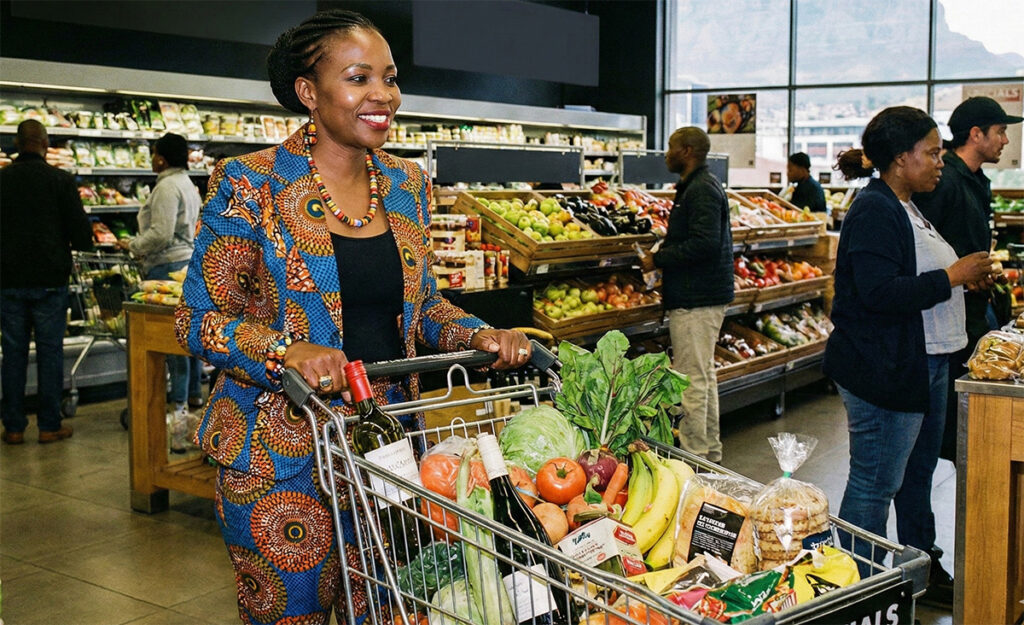
Understanding the CPI: Your “Inflation Shopping Basket”
The Statistics South Africa (StatsSA) calculates the Consumer Price Index (CPI) by tracking the prices of a “basket” of roughly 400 goods and services. This basket includes everything from mielie meal and sunflower oil to school fees and funeral cover.
When we talk about Inflation Targeting in SA, we are looking at the percentage change in the cost of this basket over time. However, there is a catch: the “official” inflation rate might be 5%, but your personal “grocery inflation” might feel like 12%. This is because food and fuel—the two things we buy most often—frequently rise faster than the overall average.
Why Food Prices Rise Faster Than General Inflation
- Input Costs: Farmers face higher costs for fertilisers and seeds, which are often imported.
- Energy Costs: Irrigation and cold storage require electricity. When Eskom rates rise, those costs are passed to you.
- Logistics: South Africa relies heavily on road freight. A rise in the diesel price affects the cost of every item on the shelf.
The Direct Link: CPI and Your Grocery Bill
The relationship between Inflation Targeting in SA and your shopping list is direct and often painful. Here is how the numbers play out:
- The Announcement: StatsSA announces that CPI has risen due to high vegetable prices.
- The Policy Response: If this rise pushes inflation above the 6% target, the SARB may hike interest rates.
- The Wallet Squeeze: You now pay more for your home loan or car, leaving less “disposable income” for groceries.
- The Supermarket Shift: To compensate, you stop buying premium brands and switch to “house brands” or “no-name” products.
Impact Analysis: Inflation vs. Purchasing Power
Inflation & Your Trolley: How CPI Moves Your Money
| CPI Movement | What the SARB Does | Impact on Your Grocery Bill |
|---|---|---|
| Within 3% – 6% | Maintains stability; may hold rates. | Stable: Predictable rises; easier to budget. |
| Above 6% (High) | Likely to increase interest rates. | Shrinkflation: Fast hikes; smaller packs for same price. |
| Below 3% (Low) | Likely to decrease interest rates. | Better Value: Price increases slow; purchasing power grows. |
How to Beat “Grocery Inflation”
Since you cannot change the national Inflation Targeting in SA policy, you must change your strategy. Our philosophy at ECONOMY is to empower the “Economic Translator” in you to take action:
- Shop the “Basket” Focus: Pay attention to when StatsSA mentions specific items (like poultry or grains) rising. This is your cue to stock up before the next wave of retail price hikes.
- Understand “Core” vs. “Headline” Inflation: Headline inflation includes food and fuel, while core inflation does not. If headline inflation is much higher than core, it’s a sign that your grocery bill is under attack from external shocks (like oil prices).
- Diversify Your Shopping: Use price-comparison apps and loyalty programmes. In a high-CPI environment, the 5% back on a rewards card is your best defense against inflation.
- Invest in Resilience: For more long-term strategies on surviving price shocks, read our South Africa Economic Overview.
The Future of Inflation Targeting in SA
As we look toward the remainder of 2026, the SARB remains committed to its target. While there is debate among politicians about widening the target to encourage growth, the current mandate remains 3% to 6%. For the average South African, this means we should expect continued vigilance from the central bank.
Stable inflation is the friend of the poor and the middle class. While the “medicine” of high interest rates is bitter, the “disease” of hyperinflation (where your money becomes worthless) is far worse.
FAQ: CPI and the Cost of Living
1. What is “Shrinkflation”?
This is when manufacturers keep the price of a product the same but reduce the weight (e.g., a 500g bag of chips becomes 450g). This is a “hidden” form of inflation that affects your CPI basket.
2. Why is my personal inflation higher than the 5% the government claims?
CPI is an average. If you spend a large portion of your income on food and transport (which often have higher inflation rates), your “personal inflation” will be higher than the national average.
3. Does the SARB control food prices?
No. The SARB only controls interest rates. They cannot control the price of tomatoes or bread directly, but they can control the total amount of money circulating in the economy to try and slow down general price increases.
Mastering the Till
Inflation Targeting in SA might sound like a topic for a boardroom in Pretoria, but its effects are felt every time you tap your card at a till point. By understanding how the CPI works and why the SARB reacts the way it does, you can stop being a victim of price hikes and start being a strategic consumer.
Keep your eye on the numbers, but more importantly, keep your eye on the value. In an economy where every cent is being contested by inflation, being an “Economic Translator” is your greatest asset.