
Minimalist Living in a Security Estate: Is Less Really More?
Minimalist Living in a Security Estate: Discover how decluttering your home can lead to more peace, wealth, and freedom. A guide to the Soft Life.
There is a specific feeling we all chase when we sign that offer to purchase in a South African security estate.
You know the feeling. It starts when you drive up to the gatehouse. The boom lifts with a reassuring beep. You drive past perfectly manicured verges, children riding bicycles in the street without fear, and neighbors walking their dogs in the golden late-afternoon sun. It feels like you have exhaled a breath you didn’t know you were holding. It feels like safety. It feels like success.
But often, once we get the keys and move in, a different reality sets in. In our quest to fill these beautiful, secure homes, we unknowingly fill them with noise. We buy the massive lounge suite because the room is big. We fill the double garage with boxes we haven’t opened in three years. We clutter our sanctuaries with things we think we should own, rather than things that bring us joy.
We end up with a “Soft Life” exterior, but a chaotic interior.
This brings us to a question that is quietly revolutionizing the way we live in Mzansi: Minimalist Living in a Security Estate: Is Less Really More?
As Thando, your City Insider, I want to take you on a journey through a different kind of luxury. We are not talking about living in an empty white box with one chair. We are talking about curated living. We are talking about the freedom that comes when your home is as peaceful as the estate you live in.
The South African Estate Paradox
To understand why minimalism is such a powerful tool, we first need to look at the “Estate Paradox.”
In South Africa, security estates are the gold standard of living. Places like Waterfall, Val de Vie, or Steyn City represent the pinnacle of achievement. Naturally, when we move into these spaces, we feel the pressure to match the surroundings. If the house has four bedrooms, we feel the need to furnish four bedrooms—even if it’s just us and a cat. If the patio is huge, we buy a 12-seater outdoor dining set that we use twice a year.
We equate “more space” with “more happiness.”
But here is the gentle truth: Clutter is essentially deferred decision-making. Every item in your home that you don’t use or love takes up mental bandwidth. It needs to be cleaned, moved, organized, and insured.
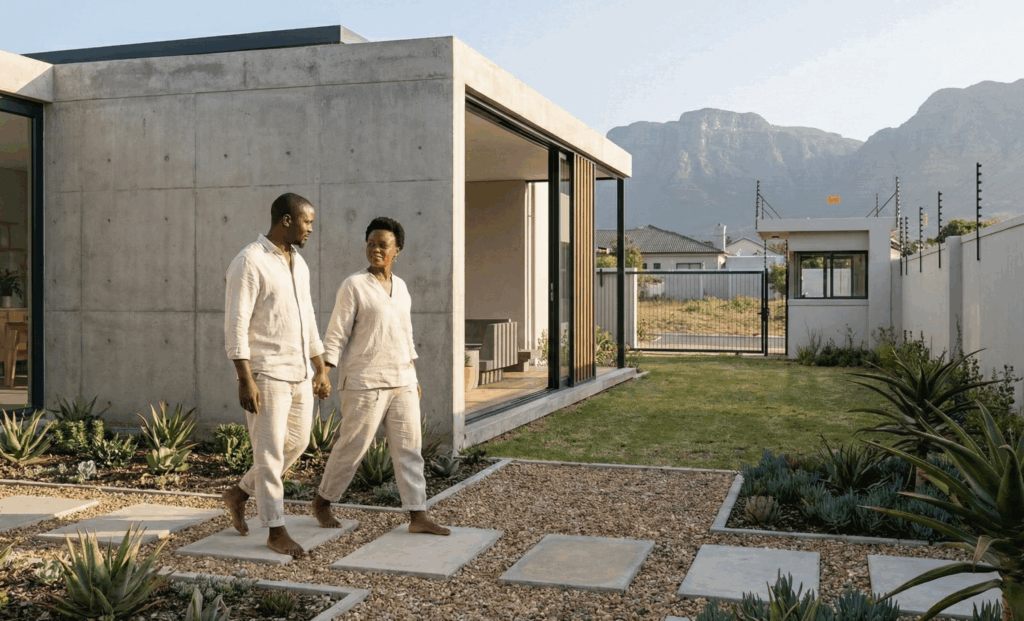
Minimalist living in a security estate flips the script. It says: “I am paying a premium for this location, this security, and this lifestyle. Why would I dilute that value by filling my space with junk?”
True luxury is space. True luxury is flow. True luxury is having a home that serves you, not a home you have to serve.
The Financial Freedom of “Less”
Let’s talk Rands and Cents, but let’s do it softly.
Living in an estate is expensive. You have the bond, the levies (which can range from R2,000 to R10,000+), the rates, and the maintenance. When you add a lifestyle of high consumption on top of that, the financial pressure can become suffocating.
This is where the concept of “Financial Minimalism” comes in.
If you stop buying decorative items to fill empty corners, stop upgrading furniture just because it’s “on trend,” and start questioning every purchase, you free up massive amounts of capital.
Imagine if, instead of buying a new R30,000 lounge suite every three years, you invested that money? Or used it to travel? Or simply put it away to create a “Freedom Fund”?
I explore this financial philosophy deeply in my guide on The Art of Living Well in South Africa: Balancing Comfort, Culture, and Cost. If you are feeling the pinch of estate levies, reading that article is your next step to finding balance.
Defining “Soft Minimalism” (It’s Not Cold)
When people hear “minimalism,” they often picture a cold, sterile hospital room. That is not the vibe we are going for. In South Africa, our aesthetic is warm. It is textured. It is welcoming.
We aim for “Soft Minimalism.”
1. Texture Over Clutter
Instead of having 50 knick-knacks on a shelf, have one beautiful clay pot. Instead of ten cheap throw pillows, have two high-quality woven wool cushions.
- The Shift: You replace visual noise with tactile comfort. A leather couch, a Nguni rug, a wooden bowl. These items bring warmth without clutter.
2. The Palette of Calm
Estates often have strict architectural guidelines, usually favoring natural tones. Lean into this inside your home.
- The Shift: Use shades of sand, stone, oatmeal, and terracotta. When the colours of your home flow seamlessly, the space feels twice as big.
3. Intentionality
This is the core rule. Every item in your home must have a purpose or a story.
- The Shift: Ask yourself, “Does this item make my life easier, or does it just look pretty?” The best items do both.
Room by Room: Curating Your Sanctuary
Let’s walk through your home and see how minimalist living in a security estate transforms everyday spaces.
The Living Room: The Breath of the Home
This is where life happens. In many estate homes, this is an open-plan space connecting the kitchen and the patio.
- The Problem: We tend to over-furnish. Side tables, coffee tables, ottomans, media units. The flow gets blocked.
- The Minimalist Fix: Float your furniture. Pull the couch away from the wall. Remove the bulky TV unit and mount the screen. Keep surfaces clear.
- The Result: When you walk in, your eye travels straight to the window and the view outside. The room feels like an exhale.
The Kitchen: The Functional Heart
Estate kitchens are usually beautiful—stone countertops, modern cabinetry. Why hide them under appliances?
- The Problem: Counters covered in toasters, blenders, knife blocks, and mail.
- The Minimalist Fix: The “One Appliance Rule.” Only the appliance you use daily (e.g., the kettle or coffee machine) stays out. Everything else lives in a cupboard.
- The Result: A clean, expansive workspace that invites you to cook healthy meals. It turns cooking from a chore into a ritual.
The Bedroom: The Sleep Sanctuary
Your bedroom should have one function: Rest.
- The Problem: It becomes a dumping ground for laundry, books, and half-packed suitcases.
- The Minimalist Fix: Remove the TV. Remove the chair in the corner that is just a clothes hanger. Invest in luxury white linen (it creates a hotel vibe instantly).
- The Result: When you enter your room, your brain receives a signal: Sleep. You rest deeper and wake up fresher.
The Garage: The Reality Check
In South Africa, the double garage is often the most cluttered room in the house.
- The Problem: We store things “just in case.” Camping gear we haven’t used since 2018. Old paint tins. Broken appliances.
- The Minimalist Fix: If you haven’t used it in 12 months, sell it on Yaga or donate it.
- The Result: You can actually park your car inside. This protects your vehicle (saving insurance excess) and declutters your arrival home.
The Estate as Your “Extended Home”
One of the biggest arguments for minimalist living in a security estate is that you simply need less because the estate provides more.
Think about it. Why do you need a massive home gym that takes up a whole room?
- The Estate: Likely has a fully equipped gym and running trails.
Why do you need a massive swimming pool that costs a fortune to maintain?
- The Estate: Likely has a clubhouse pool for those hot summer days.
Why do you need a huge jungle gym in your garden?
- The Estate: Has parks and play areas where your kids can socialize with other kids.
By embracing the communal facilities of your estate, you can downsize your private accumulation. You stop trying to replicate the world inside your four walls and start living in the community you paid to join.
This shift is liberating. It forces you out of your house and into the green spaces. It encourages connection with neighbors. It turns your home into a private retreat, while the estate becomes your playground.
The Art of “Letting Go” (Decluttering Guide)
Transitioning to this lifestyle requires a “Purge.” But let’s not call it that. Let’s call it a “Curation.”
I recommend the “Four Box Method” for a gentle weekend project:
- Box 1: Keep. Items you use weekly or truly love.
- Box 2: Donate. Good quality items that served you well but are no longer needed. Imagine the joy they will bring someone else.
- Box 3: Sell. High-value items. Use the cash to fund an experience (like a weekend away).
- Box 4: Recycle/Trash. Broken or unusable items.
Start small. Do one drawer. Then one shelf. Then one room. As you clear the physical space, pay attention to how your chest feels lighter. That is the feeling of the “Soft Life” taking root.
For inspiration on sustainable living and letting go, check out resources like The Minimalists or local SA decor blogs like Visi which often feature minimalist homes.
Overcoming “Status Anxiety”
We need to address the elephant in the room. In South Africa, material possessions are often tied to status. A full house signals “I have made it.” An empty space can sometimes feel like “I can’t afford it.”
This is a mindset trap.
The wealthiest people often have the least clutter. Look at the architecture of high-end lodges or galleries. Space is the status symbol.
Minimalist living in a security estate is the ultimate flex. It says: “I am so secure in my worth and my happiness that I don’t need to perform for anyone.”
When neighbors come over, they won’t judge your lack of clutter. They will walk in and say, “Wow, it feels so calm in here.” They will envy your peace, not your possessions.
Maintenance: The Hidden Benefit
Let’s be practical for a moment. South Africa is dusty. We have spiders. We have the occasional ant invasion.
The more stuff you have, the more you have to clean.
- Minimalist Home: A quick sweep and a wipe down. 30 minutes.
- Maximalist Home: Moving 50 items to dust underneath them. 3 hours.
If you rely on domestic help, a minimalist home allows your helper to focus on deep cleaning (windows, bathrooms) rather than spending hours organizing clutter. If you clean yourself, you reclaim your Saturday mornings.
Time is the only resource you cannot earn back. Minimalism gives you time.
Conclusion: Is Less Really More?
So, we return to our title question: Minimalist Living in a Security Estate: Is Less Really More?
The answer is a resounding yes. But it’s not just “more” space.
- It is more peace of mind.
- It is more time with your family.
- It is more money in your investment account.
- It is more appreciation for the beautiful things you do choose to keep.
Your estate offers you a secure perimeter. Let minimalism offer you a secure interior. Create a home that acts as a filter for the chaos of the world, not a container for it.
Open your curtains. Let the light in. Breathe. Welcome to your true Soft Life.
Have you started decluttering your home? What was the hardest item to let go of? Share your story in the comments below!
FAQ: Minimalist Estate Living
Q: Will my house look empty or poor if I minimize?
A: Not if you do it with intention. Focus on scale. If you have a large room, use larger furniture pieces (like a substantial rug or a large artwork) rather than many small pieces. It looks sophisticated, not empty.
Q: I have kids. Is minimalism even possible?
A: Yes, but it looks different. It’s not about having zero toys; it’s about having a system. Use stylish baskets to hide toys in the living area. Implement a “one in, one out” rule for new toys. It teaches children to value what they have.
Q: Where can I donate my goods in South Africa?
A: Organizations like The Salvation Army or Hospice shops are wonderful. Many estates also have community drives where they collect goods for staff or local charities. Ask your HOA.
Q: Does minimalism help with moving house?
A: Absolutely. South Africans move often (semigration etc.). Moving a minimalist home is cheaper (less volume for the movers) and less stressful. You are always “ready” for the next adventure.
Q: How do I start if I am overwhelmed?
A: Start with the “surface rule.” Clear all flat surfaces (counters, tables, desks). Put everything in a box. Only take out what you use. After 30 days, whatever is left in the box gets donated.