
The Gig Economy: Best Platforms for Freelancers in SA
Start earning in Rands or Dollars. Zama reviews the best platforms for freelancers in SA (Upwork, NoSweat, OfferZen) and covers tax and payment tips.
The traditional 9-to-5 is evolving. In South Africa, where the formal unemployment rate is stubbornly high, the Gig Economy has emerged not just as a stop-gap, but as a legitimate career path for millions. In 2026, freelancing is no longer just for graphic designers and writers; it is for accountants, engineers, virtual assistants, and project managers.
Whether you are looking to escape the corporate grind entirely or simply want to supplement your income to combat inflation, the gig economy offers unparalleled freedom. However, it also offers unparalleled competition. To succeed, you need to know where to look. Throwing a generic profile onto the wrong platform is a waste of time. To understand how the gig economy fits into the broader employment landscape, start by reading our analysis on navigating the South African job market.
This guide curates the best platforms for freelancers in South Africa, breaking down the global giants that pay in Dollars and the local heroes that connect you with top SA corporates.
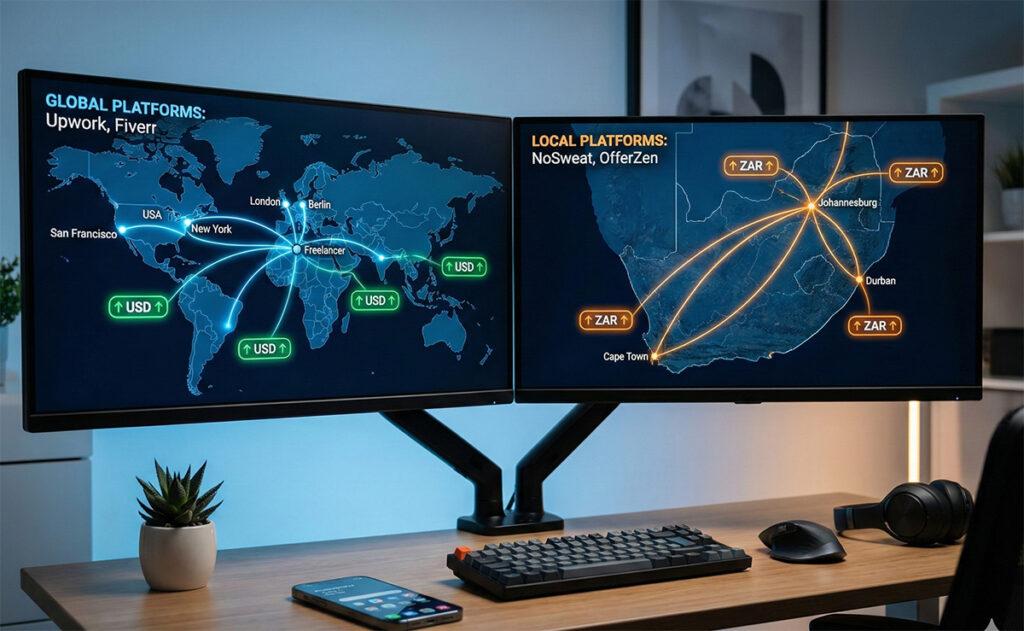
Global vs. Local: The Strategic Choice
Before you sign up, you need to choose your battlefield.
- The Global Route (Upwork, Fiverr):
- Pros: You earn in USD, GBP, or EUR. When converted to Rands, even a “low” international rate can be a premium local salary. The pool of clients is massive.
- Cons: You compete with the entire world—specifically low-cost talent from India, the Philippines, and Eastern Europe. Payment friction can be high (PayPal fees).
- The Local Route (NoSweat, Rent-a-Pro):
- Pros: Less competition. Clients understand the South African context (BEE, time zones, language). Payments are instant via EFT.
- Cons: You earn in Rands. The market is smaller.
The Global Giants: Earning Hard Currency
If your goal is to leverage the exchange rate (“Geo-Arbitrage”), these are the platforms you must master.
1. Upwork (The Corporate Standard)
This is the biggest marketplace in the world. It is ideal for long-term contracts and professional services (Admin, Dev, Legal, Accounting).
- The SA Strategy: Don’t compete on price; compete on time zone (GMT+2 aligns with Europe) and English proficiency.
- The “Connects” System: You have to pay to pitch. Be selective. Only apply for jobs where you are a 100% match.
- Getting Paid: Use a Wise account to receive USD and transfer to your Standard Bank/FNB account. It is cheaper than PayPal.
2. Fiverr (The Productised Service)
Fiverr is different. You don’t pitch; clients come to you based on your “Gig” (a packaged service).
- The SA Strategy: Niche down. Don’t just offer “Logo Design.” Offer “Minimalist Logo Design for Cape Town Real Estate Agents.” Specificity sells.
- Upselling: The money isn’t in the $5 gig; it’s in the “Extra Fast Delivery” or “Source File” add-ons.
3. Toptal (The Elite 3%)
If you are a Senior Developer, Finance Expert, or Project Manager, apply here. Toptal screens heavily (only accepting the top 3% of applicants), but once you are in, you get access to Fortune 500 clients and high hourly rates ($50 – $150/hr).
Zama’s HR Secret: On global platforms, your location can be a bias trigger. While you should never lie, emphasize your “British English” native proficiency and your alignment with European time zones in your bio. This mitigates the fear some international clients have regarding communication barriers.
The Local Heroes: South African Platforms
Sometimes, you want to work with clients who understand what “Load Shedding” means and won’t schedule a call during Stage 4.
1. NoSweat (Creatives & Advertising)
If you work in advertising, film, copywriting, or design, NoSweat is the industry standard in SA.
- How it works: It connects freelancers with ad agencies and production houses looking for short-term specialized skills.
- Why it wins: They handle the billing. You don’t have to chase the client for payment; NoSweat pays you.
2. Rent-a-Pro (General Services)
This is the “Jack of all trades” platform for South Africa. It covers everything from accounting and legal services to photography and tradesmen.
- Best for: Local service providers who need to build a client base in their specific city (e.g., “Photographer in Durban”).
3. RecruitMyMom (Flexible & Skilled)
Don’t let the name fool you; this is a powerhouse for skilled professionals seeking flexible or part-time work. It focuses on the “maternal” workforce but places high-level accountants, HR managers, and virtual assistants.
- Best for: Professionals who want high-quality corporate work but cannot commit to a 40-hour office week.
4. OfferZen (Developers)
While primarily for full-time roles, OfferZen has opened up opportunities for contract work in the tech space. If you are a dev in SA, you simply must be here. Companies apply to you, not the other way around.
The Admin Reality: Taxes and Payments
The gig economy is not tax-free. SARS is watching. As soon as money hits your account, it is income.
- Provisional Tax: If you are a freelancer, you are likely a “Provisional Taxpayer.” This means you must file returns twice a year (August and February) to prevent a massive tax bill.
- Declaration: You must declare all income, whether it is from Upwork in Dollars or a local EFT.
- Deductions: The good news? You can deduct business expenses (internet, laptop, home office portion).
For a complete guide on how to stay compliant without losing your mind, read our essential guide on side hustle taxes: how to declare extra income.
Monday Morning Checklist: Launch Your Gig Profile
Don’t just “think about it.” Spend this week setting up your shop.
- Choose One Platform: Don’t try to be everywhere. Pick one (e.g., Upwork for Admin, NoSweat for Creative) and go deep.
- Build Your Portfolio: If you don’t have client work yet, create “spec work.” Redesign a famous logo. Write a blog post for a pretend client. You need to show what you can do.
- Record a Video Intro: Platforms like Upwork boost profiles that have a 60-second video. sit in good light, smile, and introduce yourself. It builds trust instantly.
- Set Your Rate: Look at what others in SA are charging, and add 20%. It is easier to lower your price later than to raise it.
FAQ: Freelancing in SA
Is PayPal the only way to get paid internationally?
No, and it is often the most expensive due to FNB withdrawal fees. Look at Wise (formerly TransferWise) or Payoneer. They offer better exchange rates and lower fees for South Africans.
Do I need a VAT number?
Only if your turnover (total sales) exceeds R1 million in a 12-month period. If you are just starting, you do not need to register for VAT.
Can I freelance while working a full-time job?
Check your employment contract. Most contracts require you to declare “secondary income” or “moonlighting” to ensure there is no conflict of interest. Be transparent to avoid dismissal.
What is the biggest mistake SA freelancers make?
Underpricing. Do not price yourself as “cheap labour.” Price yourself as “high-value skilled talent in a cost-effective region.” There is a psychological difference.
The gig economy is a meritocracy. Your degree matters less than your rating. Your location matters less than your internet connection. In 2026, the world is your client—if you are brave enough to pitch.