
The Rand Volatility: Why Our Currency Fluctuates and What It Means
Discover why the Rand is so volatile and how currency fluctuations impact your grocery bills and fuel prices. Lesedi Dlamini explains the ZAR rollercoaster.
If there is one thing that keeps South African business owners and households awake at night, it is the exchange rate. We often wake up to headlines declaring the Rand has “tumbled” or “surged” against the US Dollar, often with very little explanation of why it happened or what it means for the person waiting in the queue at the petrol station. Understanding The Rand Volatility is not just for currency traders; it is a vital part of managing your personal finances in a globalised economy.
As an emerging market currency, the South African Rand (ZAR) is known globally for its “high beta” status—meaning it swings more violently than many other currencies. In this cluster guide, we will dive deep into the mechanics of these fluctuations and how they ripple through your bank account.
The Mechanics of Currency: Why the Rand Moves
At its core, the value of the Rand is determined by supply and demand on the global foreign exchange market. If more people want to buy Rands (to invest in our mines, buy our government bonds, or visit our shores), the value goes up. If they want to sell Rands to move their money to “safer” havens like the US Dollar or Swiss Franc, the value goes down.
However, the Rand is rarely judged on South African merits alone. Because we have deep, liquid financial markets, the Rand is often used by global investors as a “proxy” for all emerging markets. This means if there is trouble in Turkey or Brazil, the Rand might get sold off simply because it is easy to trade, regardless of what is happening in Pretoria.
Internal vs. External Factors
- External Factors: These include changes in US interest rates, global commodity prices (gold, platinum, coal), and geopolitical tensions. When the US Federal Reserve raises interest rates, investors often pull money out of South Africa to earn a “safer” return in Dollars.
- Internal Factors: Load shedding, political stability, fiscal policy, and our credit rating. If the world perceives South Africa as becoming riskier to do business in, the demand for the Rand drops instantly.
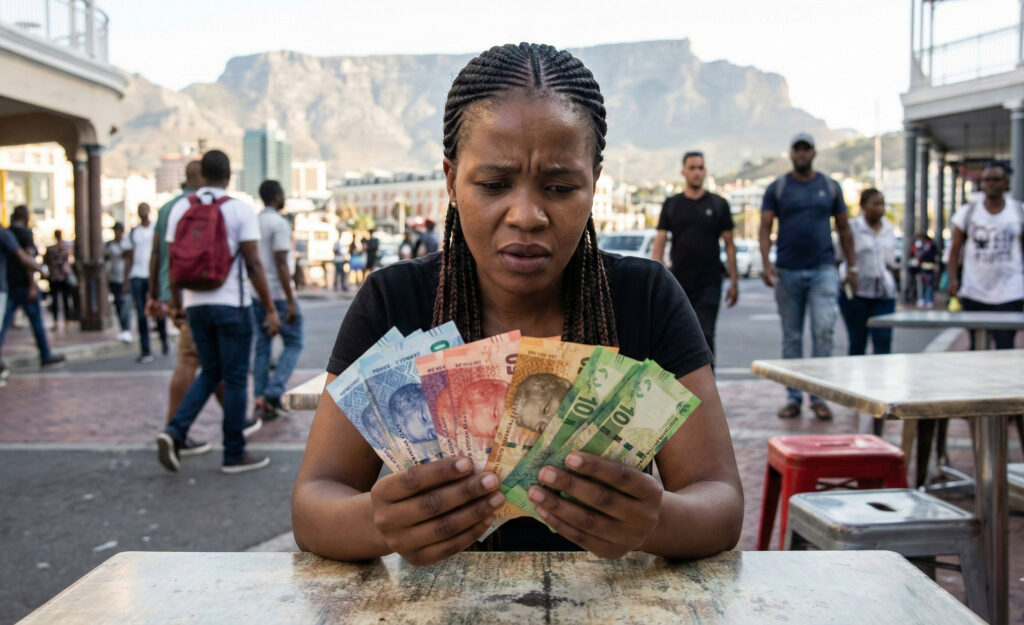
The “So What?” Factor: How Volatility Hits Your Wallet
The term The Rand Volatility sounds academic until you realise it is the reason your favorite imported coffee or latest smartphone just increased in price by 15% overnight.
1. The Petrol Pump Connection
South Africa imports the vast majority of its crude oil. Since oil is traded globally in US Dollars, the exchange rate is 50% of the formula used to calculate our monthly fuel price. Even if the global price of oil remains flat, a 10% drop in the Rand’s value will lead to a significant hike at the pumps. This, in turn, increases the cost of transporting food, leading to “shelf-price inflation.”
2. Technology and Appliances
From iPhones to washing machines, almost all high-end electronics are imported. Retailers often hedge their currency risks, but prolonged Rand weakness eventually forces them to adjust prices upward. If you are planning a major tech purchase, monitoring The Rand Volatility can save you thousands.
3. Travel and International Education
For South Africans dreaming of a holiday in Europe or the US, a volatile Rand can turn a budgeted trip into a financial nightmare. Your purchasing power literally evaporates as the Rand weakens, making every meal and hotel stay more expensive in local terms.
Lesedi’s Economic Insight: The Seesaw Analogy
Think of the Rand and the US Dollar on a seesaw. When the “Global Risk” weight is heavy, the Dollar side goes up, and the Rand side goes down. We are currently on a very sensitive seesaw where even a small comment from a global central banker can send us flying.
Impact Analysis: A Weak Rand vs. A Strong Rand
The Rand Seesaw: How Currency Swings Affect Your Life
| Scenario | Impact on the Economy | Impact on Your Wallet |
|---|---|---|
| Weak Rand (Depreciation) | Exporters win: Mining and farming earn more Rands for global goods. | Consumers lose: Fuel and food prices rise. Imported tech becomes luxury. |
| Strong Rand (Appreciation) | Debt relief: Helps the government pay off foreign-denominated debt. | Consumers win: Lower inflation pressure and cheaper travel/electronics. |
The Role of Commodities in Rand Value
South Africa is a mineral-rich nation. We are one of the world’s largest producers of platinum, gold, and manganese. Therefore, The Rand Volatility is often tied to the “Commodity Cycle”. When global demand for these minerals is high, the Rand tends to strengthen.
When China’s manufacturing sector slows down, they buy less of our iron ore and coal. This decrease in demand for our exports means less foreign currency flowing into the country, which ultimately weakens the Rand.
Is Volatility Always Bad?
While extreme swings make planning difficult, a certain level of volatility is a natural part of a “floating” exchange rate system. It acts as a shock absorber. If our economy is struggling, a weaker Rand makes our exports cheaper and more attractive to the rest of the world, which can eventually help stimulate growth and job creation.
However, for the average household, the primary concern is the “inflationary pass-through.” This is the speed at which a weak currency turns into higher prices at Checkers or Woolworths.
How to Hedge Against Rand Volatility
Since we cannot control the South African Reserve Bank (SARB) or global markets, we must control our exposure.
- Diversify Your Assets: Don’t keep all your “eggs” in a ZAR basket. Consider offshore investments or Dollar-denominated assets to balance your portfolio. For more on this, see our South Africa Economic Overview.
- Timing Big Purchases: If you need to buy imported equipment for a business or a new vehicle, try to lock in prices during periods of relative Rand strength.
- Local Consumption: Reducing reliance on imported goods is the most effective way to “Rand-proof” your daily life. Supporting local producers means your grocery bill is less sensitive to what happens on the New York Stock Exchange.
Future Outlook: Predicting the Unpredictable
Looking ahead into 2026, The Rand Volatility is expected to remain a permanent fixture of our economic landscape. While we hope for a period of “Rand recovery” as local infrastructure improves, global shifts in interest rates will continue to cause ripples.
According to data from Statistics South Africa (StatsSA), currency-induced inflation remains one of the top risks to household stability. Staying informed is no longer just for the wealthy; it is a prerequisite for anyone trying to maintain their standard of living in the “New South Africa.”
FAQ: Understanding the Currency Swing
1. Does a weak Rand mean South Africa is “going bankrupt”?
No. A weak currency is often a reflection of global sentiment or specific trade balances. Many strong economies have currencies that fluctuate. The danger is not the weakness itself, but the speed of the decline and its impact on debt.
2. Why does the Rand fall when there is trouble in other countries?
The Rand is an “emerging market proxy.” Investors often trade the Rand as a way to bet on (or against) the entire developing world because our markets are so easy to enter and exit.
3. Can the government “fix” the Rand at a certain price?
Technically, they could, but it would be disastrous. “Pegging” a currency requires massive foreign exchange reserves that South Africa does not have. A floating Rand, though volatile, allows the market to find its own level.
Living with the Rollercoaster
The Rand Volatility is a double-edged sword that defines our economic interaction with the world. While it brings uncertainty to our travel plans and grocery budgets, it also highlights the interconnectedness of our mining and agricultural sectors with the global stage.
By understanding that the Rand is a “mood ring” for global and local stability, you can better prepare for the price hikes before they happen. Don’t let the headlines panic you; instead, use the information to adjust your budget, reduce your debt, and diversify your savings. In the world of South African finance, knowledge isn’t just power—it’s protection.