
Understanding Your Payslip: UIF, SDL, and PAYE Explained
Confused by deductions? Zama explains your South African payslip, decoding PAYE, UIF, and SDL so you can audit your earnings and ensure compliance.
There is a specific kind of heartbreak that every South African professional knows. It is the moment you receive your job offer, celebrate the “Gross Salary” figure, and then, a month later, look at your bank account and see the “Net Pay.” The gap between the two can feel like a robbery.
However, viewing your payslip as a disappointment is a mistake. It is actually a legal contract and a compliance audit. It tells you exactly where your money is going and whether your employer is upholding their legal obligations. In an economy as fluctuating as ours, financial literacy starts with understanding the deductions that reduce your take-home pay. Before you look for a new role to increase that number, ensure you understand the baseline by reading our guide on navigating the South African job market.
This article decodes the “alphabet soup” of South African payroll—PAYE, UIF, and SDL—so you can audit your earnings with confidence.
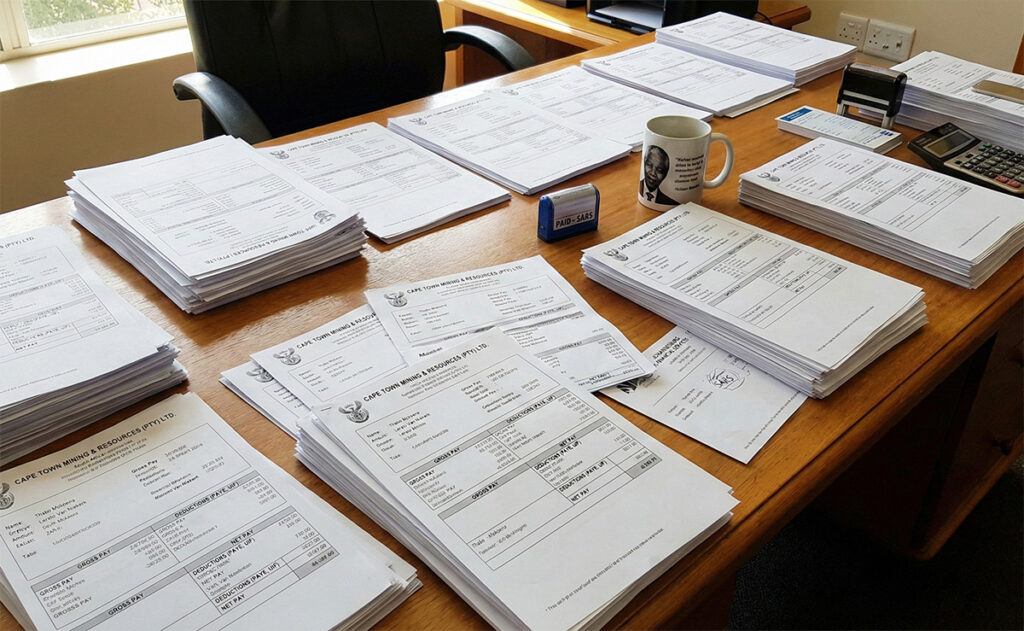
The Anatomy of a South African Payslip
To read a payslip, you must understand the three layers of money.
- Cost to Company (CTC): This is the total amount the company budgets for you. It includes your salary plus their contributions to your pension, medical aid, and skills levies.
- Gross Salary: This is the amount before deductions. This is usually the number cited in your employment contract.
- Net Pay: This is the cash that lands in your account.
- Formula: Gross Salary – (Statutory Deductions + Voluntary Deductions) = Net Pay.
Zama’s HR Secret: Never throw away your payslips. When you apply for a bond or vehicle finance, banks require the last 3 to 6 months of payslips. If you spot an error on your IRP5 tax certificate at the end of the year, your monthly payslips are your only proof to fight SARS or your employer.
The Big Three: Statutory Deductions
These are not choices; they are law. If your employer is not deducting these, you (and they) are in trouble.
1. PAYE (Pay As You Earn)
This is the tax you pay to the South African Revenue Service (SARS). Unlike the US, where you pay tax at the end of the year, South Africa deducts it monthly.
- How it works: We use a “sliding scale” or progressive tax system. The more you earn, the higher percentage you pay on the portion above the threshold.
- The Threshold: If you earn below a certain annual amount (adjusted annually by the Minister of Finance), you pay zero income tax.
- Rebates: Every taxpayer gets a “primary rebate” which reduces the tax payable.
2. UIF (Unemployment Insurance Fund)
This is your safety net. It insures you against loss of income due to retrenchment, illness, or maternity/parental leave.
- The Calculation: 2% of your salary goes to the fund.
- 1% is deducted from your Gross Salary.
- 1% is contributed by your employer (over and above your salary).
- The Ceiling: There is a cap on UIF contributions. As of the latest legislation, the ceiling is calculated on a maximum salary amount (currently R17,712 per month). If you earn R50,000, you only pay 1% of R17,712, not 1% of R50k.
3. SDL (Skills Development Levy)
This often confuses employees.
- What is it? A levy used to fund SETAs (Sector Education and Training Authorities) to develop skills in the country.
- Who pays? Technically, the employer pays this (1% of total payroll).
- Why is it on my payslip? Some companies list it for transparency to show the total “Cost to Company,” but it should not be deducted from your Gross Salary. If you see SDL being subtracted from your pay, query it immediately.
Voluntary Deductions: Benefits vs. Cash
These are deductions you agree to in your contract. While they reduce your Net Pay, they are crucial for long-term wealth.
Medical Aid vs. Medical Insurance
Contributions to a registered Medical Aid Scheme (like Discovery, Bonitas, or Fedhealth) offer a tax benefit.
- Tax Credits: You receive a fixed “Medical Tax Credit” for yourself and each dependent. This reduces your PAYE liability monthly, meaning you pay less tax.
Pension / Provident Fund
Saving for retirement is the smartest tax hack in South Africa.
- The Benefit: You can deduct up to 27.5% of your remuneration/taxable income (capped at R350,000 per year) for retirement fund contributions. This lowers your taxable income bracket, effectively meaning SARS subsidizes your savings.
Auditing Your Payslip: The “Trust but Verify” Method
Administrative errors happen. Payroll software glitches. Humans make mistakes. Here is how to audit your slip.
- Check the Tax Number: Ensure your SARS Income Tax number is listed and correct. If it is missing, your employer might not be paying your tax over to SARS.
- Verify the UIF: Look at the UIF deduction. Is it exactly 1% of your gross (or the capped amount)? If it varies, something is wrong.
- Compare Net Pay: If your salary hasn’t changed, your Net Pay should be identical to last month. A variance of even R50 implies a change in tax tables or a deduction error.
If you notice discrepancies, you need to sort them out before tax season opens. For a full breakdown on how these slips translate into your annual filing, read our guide on filing your tax return: SARS guide.
Monday Morning Checklist: The Payslip Audit
- Log into SARS eFiling: Check if your employer has actually been paying your PAYE. You can request a “Statement of Account” or look at your IRP5 status.
- Check Your uFiling Status: Log into the Department of Employment and Labour uFiling system. Ensure you are registered. If you get retrenched and your employer never registered you, claiming benefits becomes a nightmare.
- Digital Archive: Create a folder on Google Drive or iCloud named “Payslips 2026”. Download and save your PDF payslip every single month. Do not rely on your work email (which you lose if you get fired).
FAQ: Payslip Questions
What is a “Garnishee Order” (Emoluments Attachment Order)?
If you have unpaid debts, a court can order your employer to deduct money directly from your salary to pay the creditor. This will appear on your payslip. Your employer cannot refuse this order.
Why is my December Net Pay different?
This often happens due to tax recalculations on bonuses (13th cheques). Bonuses are taxed, often at a higher effective rate during that month, which is then smoothed out on assessment.
Can I opt out of UIF?
No. If you work more than 24 hours a month, UIF is mandatory. The only exceptions are for workers who work less than 24 hours a month or learners under the Skills Development Act (in some cases).
My employer deducts tax but doesn’t give me a payslip. Is this legal?
No. Section 33 of the Basic Conditions of Employment Act (BCEA) explicitly states that an employer must provide a payslip containing specific details (Employer name, Employee name, period, remuneration, deductions) on every payday.
Understanding your payslip is the first line of defense in protecting your financial rights. It ensures you get what you earned and that your safety nets are active.