Loading...
The Sleep-Friendly Bedroom Setup: 7 Small Upgrades for Better Rest

A practical guide to a sleep-friendly bedroom in South Africa — light, sound, temperature and small habit shifts that actually improve rest.
Why the bedroom itself matters more than another sleep app
You can have the perfect bedtime, the perfect wind-down playlist, a magnesium tablet and a journal next to your bed — and still wake up feeling like you slept on a couch. The bedroom itself does most of the work. The room you are sleeping in is doing more for your rest, or against it, than almost any habit you layer on top.
This article is about seven small upgrades to the room itself. Most are about removing things, not adding things. By the end of the week, your bedroom should feel slightly quieter, slightly darker and slightly more set up to do its one job.
TIP
Pick three of the seven to start with. Trying to fix everything at once usually means you do not finish. The South African Sleep Foundation and many other sleep researchers agree on one thing: consistency beats perfection.
1. Make the room properly dark
Light is the most studied lever in sleep research. Even small amounts of light through the eyelids interfere with the deep stages of sleep. The World Health Organization and a long line of peer-reviewed sleep studies have found that darker rooms produce better sleep quality, especially in the second half of the night.
For most South African flats and houses, “dark” means dealing with three things:
- The streetlight outside. Most suburbs have a streetlight within twenty metres of a bedroom window. The light it casts on the ceiling is enough to disrupt sleep.
- Indicator lights inside the room. The standby light on the TV, the charging light on a router, the LED on the air freshener. There are usually more than you realise.
- Early sunrise in summer. From about October to March in most parts of South Africa, the sun is up well before 6am.
The fix is layered:
- Get blackout curtains or blackout liners. The basic roller-blind blackouts from places like Builders, Mr Price Home or Hertex work fine. They do not need to be designer. They need to be opaque.
- Cover or move indicator lights. A small piece of black electrical tape over the worst offenders is enough. Move chargers out of the bedroom if you can.
- Use a sleep mask as backup. If you cannot fully control the room (shared windows, security lights you cannot move), a soft silk or cotton mask covers what the curtains miss.
Do this for one week and then judge. Most people notice within five nights.
2. Cool the room down
The body sleeps best when it is slightly cool. The Sleep Foundation, the Mayo Clinic and most modern sleep researchers agree on a range of roughly 16–19°C as ideal for the main sleeping hours. Hotter than that and your body works harder to cool itself, which fragments sleep.
In South Africa this matters in two different ways depending on where you live:
- Highveld winters (Joburg, Pretoria, Bloemfontein): the issue is usually too much heating. People run heaters all night or close the windows so tightly the room becomes stuffy. Turn the heater off about thirty minutes before bed. Crack a window. Use a thicker duvet instead.
- Coastal summers (Durban, Cape Town, Port Elizabeth): the issue is humidity and heat. A small bedside fan moving air across the bed does more than you would think. Light cotton sheets (not polyester) breathe better.
You do not need air conditioning. You need the room to be cool enough that you can pull the duvet up. If you are kicking it off all night, the room is too warm.
3. Choose the right pillow for how you sleep
Most people are using the wrong pillow because they bought it five years ago and never thought about it again. The right pillow keeps your head in line with your spine, which prevents the neck pain that wakes you up at 3am.
A rough guide:
- Back sleepers want a medium-thickness pillow. The neck should stay neutral, not pushed forward.
- Side sleepers want a thicker, firmer pillow. The gap between the head and the mattress is bigger, so the pillow needs to fill it.
- Stomach sleepers want a thin pillow, or no pillow under the head at all. A thick pillow pushes the neck up at an angle.
Replace pillows every two to three years. If your pillow does not bounce back when you fold it in half, it is finished.
For mattresses, the rule of thumb is harsher: a mattress lasts 7-10 years for most adults. If you wake up sore consistently, it might not be your back — it might be the mattress.
4. Remove the work from the room
The bedroom should not double as an office. When you work from where you sleep, your brain links the room with stress, and falling asleep gets harder.
If you live in a flat where there is genuinely no other space (this is the case for many people in city apartments), at least do this:
- Get a folding screen, a curtain, or even a tall plant to visually separate the desk from the bed.
- Pack the work things away at the end of the day. Close the laptop, put the notebook in a drawer, turn the desk lamp off. The desk should look “off” by the time you are in bed.
- Do not work from bed. Even when it is tempting. Even on Sundays.
The brain is not strict about furniture. It is strict about associations.
5. Make the bed every morning
The bed should feel inviting at the end of the day, not like a pile of yesterday. Making the bed every morning takes 90 seconds and changes the entire visual feel of the room.
The minimum is:
- Pull up the bottom sheet so it is flat.
- Pull up the duvet.
- Plump the pillows.
- Smooth the top.
That is it. You do not need to do hospital corners. You do not need a stack of decorative cushions. The point is that when you walk into the room at 9pm, it looks like a place for rest, not a place where life happened all day.
The South African Department of Health does not have a specific recommendation on making the bed. But every habit psychologist who has written about morning routines lists it as one of the highest-return small habits there is.
6. Manage the noise
Bedrooms in cities are loud. Traffic, neighbours, dogs at night, the security gate of the complex opening at 2am. There are three approaches and you can combine them.
Soft surfaces absorb sound. A rug on the floor, curtains over the windows, a quilt or fabric headboard behind the bed — all of these reduce the echo and the sharp edges of street sounds.
A consistent low sound covers irregular sound. A small fan, a white-noise machine, or even a phone on aeroplane mode playing a sleep sound from a downloaded file. The trick is consistency: it is the change in sound that wakes you up, not the volume.
Earplugs are a last resort. Some people love them, some find them uncomfortable. Soft foam earplugs are easy to find at any pharmacy. Try them for a week if the noise is genuinely the problem.
A specific note for South African suburbs: if dogs barking in your area is the main issue, the consistent low sound trick works surprisingly well. The fan or white noise covers the gaps, so the dog at 11pm does not wake you the way it would in silence.
7. Set a phone curfew
This one gets the eye-rolls. It is still on the list because the research is consistent and most people genuinely do feel a difference within a week.
Two layers:
Layer one: charge the phone in another room. If that is impossible (you have small kids, or the phone is your alarm), put it on the other side of the bedroom on a low shelf. Out of arm’s reach from the bed.
Layer two: stop using the phone 30 minutes before sleep. Not because of “blue light”, which is a smaller factor than the news cycle suggested for a while. The bigger factor is mental: doomscrolling, work emails, group chats, comparison-induced anxiety. The half-hour buffer is what helps most.
Replace the phone with something low-stimulation in that half hour:
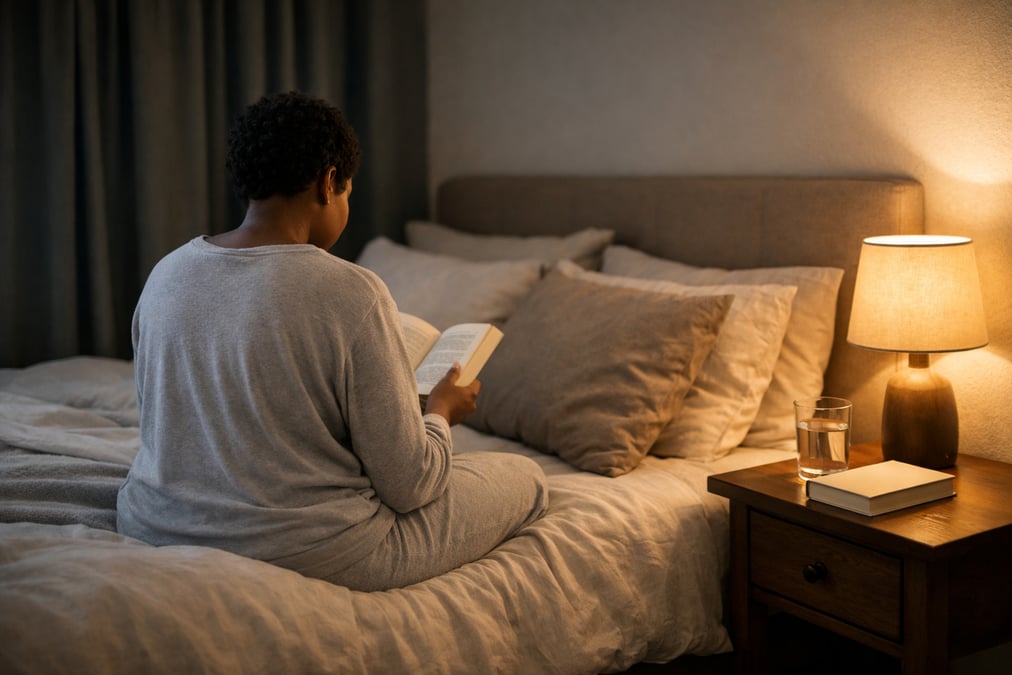
- A paper book (fiction works better than non-fiction).
- A magazine.
- A long-form interview podcast at low volume.
- A short conversation with someone you live with.
- Nothing. Sitting on the side of the bed and looking at the ceiling is also valid.
If the phone is your alarm, replace it with a small standalone alarm clock. The phone then moves to the hallway.
Putting it together this week
Day 1-2: Darken the room. Hang or close blackout liners. Cover the indicator lights. Try a sleep mask if needed.
Day 3-4: Cool the room. Adjust the heater or fan settings. Switch heavy bedding for breathable bedding if it is summer.
Day 5: Check the pillow. If it does not pass the fold-in-half test, plan to replace it.
Day 6-7: Move the work out of the bedroom. Set up the visual separation, even if it is just a closed laptop on a shelf.
After a week of small changes, the difference in how rested you feel will tell you which one mattered most for your situation. From there you can refine.
IMPORTANT
If you have tried these adjustments and you are still waking up tired most days, talk to a GP or a sleep specialist. Persistent fatigue can have causes a darker room will not fix, including iron deficiency, sleep apnoea, thyroid issues and others. The South African Society of Sleep Medicine has a list of accredited specialists on their website.
The point of all this
A sleep-friendly bedroom is not about minimalism, designer sheets or an Instagram aesthetic. It is about removing the friction between you and rest. Most South African bedrooms have small frictions stacked on top of each other — a streetlight, a noisy router, a too-warm room, a phone on the pillow. Removing three of them is usually enough to feel a real difference.
Tonight, do one thing. Cover the brightest indicator light in the room. Tomorrow, do another. By next Sunday, the room will be doing the work for you.
Useful sources

Thando Mokoena
Lifestyle Writer
Thando Mokoena is a lifestyle writer who explores how South Africans can live well without breaking the bank. From side hustles and money-saving apps to cultural experiences and wellness, she covers the intersection of lifestyle and smart financial choices.
Related reading

The Rise of Non-Alcoholic Drinks: Exploring SA’s Sober Curiosity
It is Friday afternoon. The golden hour is hitting the Johannesburg skyline, or perhaps painting Table Mountain in shades of purple and orange.

The 20-Minute Morning Routine: How to Start Your Day Calm and Focused
A simple 20-minute morning routine for South African weekdays — hydration, light, breath, and a small daily anchor that calms the day ahead.

Cultural Etiquette: Navigating South Africa’s Diverse Social Circles
A friendly guide to South African social etiquette — greetings, gatherings, and the small cues that smooth interactions across our many cultures.